The Best AI Models for Roleplay and Storytelling: Local LLMs vs. Cloud APIs
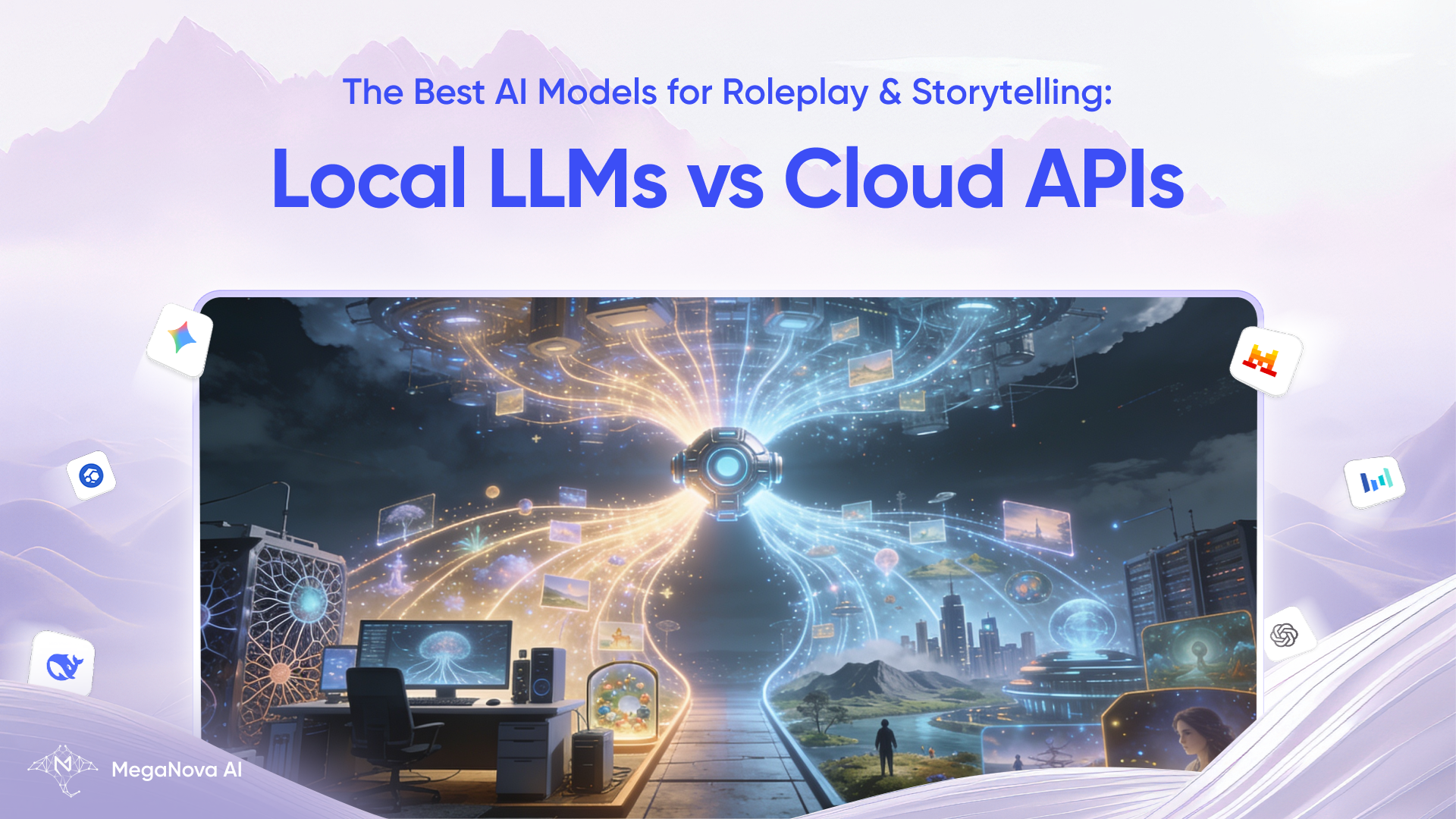
If you've already settled on a frontend like SillyTavern or Janitor AI, the next — and arguably more important — decision is what's actually generating your characters' responses. The frontend is just the cockpit; the model is the brain doing the writing.
That choice boils down to two fundamentally different approaches: run a model yourself on your own hardware (local), or rent access to a model hosted somewhere else (cloud API). Each comes with real tradeoffs in quality, cost, privacy, and creative freedom. Here's how to think about both.
Local LLMs: Running Your Own Model
A local LLM runs entirely on your PC, Mac, or home server using tools like LM Studio, Ollama, or KoboldCpp. The model weights live on your drive, and every token is generated by your own GPU (or CPU, if you're patient).
🟩 The Pros:
- Total Privacy: Nothing leaves your machine. No logs, no account, no third party ever sees your chats or characters.
- No Per-Message Cost: Once you've got the hardware, generation is effectively free and unlimited — no rate limits, no surprise bills.
- Maximum Creative Freedom: Open-weight models don't carry a provider's content policy, so you decide what's in or out of bounds for your stories.
- Offline-Capable: No internet required once the model is downloaded.
🟥 The Cons:
- Hardware Matters: Quality scales with VRAM. Small models (7B–13B) run on modest GPUs but can feel repetitive or "robotic" without careful prompt tuning; larger models that rival cloud-tier writing need serious GPU horsepower.
- Setup Overhead: Picking the right quantization, context size, and sampler settings is its own small hobby.
- Behind the Frontier: The best local models have closed the gap significantly, but the very top cloud models still generally edge them out on long-range reasoning and nuanced prose.
Worth knowing about in 2026: Smaller, efficient open-weight models (in the 8B–12B range) have become popular picks for modest GPUs, prized less for raw size and more for how well they hold a character's voice over a long chat.
On the higher end, larger open-weight releases have pushed context windows and reasoning quality close to what cloud providers offer, making "run it yourself" a much more credible option than it was even a year or two ago.
Community fine-tunes built specifically for roleplay and creative writing (often based on Llama or Mistral architectures) remain a go-to source for models tuned to stay in-character rather than slip into generic chatbot phrasing.
Cloud APIs: Renting the Best Brains
A cloud API means your frontend sends each message to a remote server — OpenAI, Anthropic, Google, DeepSeek, xAI, and others — and gets a response back. You pay per token (or use a proxy/free tier), and there's nothing to install beyond pasting an API key into SillyTavern or Janitor's settings.
🟩 The Pros:
- Best-in-Class Writing: Frontier models simply produce more coherent, nuanced prose and track plot/character details better over very long sessions.
- Huge Context Windows: Several flagship models now support context windows in the hundreds of thousands to millions of tokens — enough to hold an entire novel's worth of history without summarization tricks.
- Zero Setup: No GPU, no quantization decisions — just an API key.
- Constantly Improving: New model versions ship frequently, often with no extra effort on your end beyond updating a model ID.
🟥 The Cons:
- Per-Token Cost: Long roleplay sessions add up, especially with larger context windows.
- Content Policies Vary: Each provider sets its own rules about what kinds of content their models will and won't generate, and these can be stricter than what a local model allows.
- Your Data Leaves Your Device: Even with privacy commitments from providers, your messages are processed on someone else's servers.
How the major providers tend to stack up for fiction:
- Anthropic's Claude models are frequently singled out for literary prose quality, subtext, and character psychology — strong picks when the writing itself is the priority.
- Google's Gemini line tends to lead on context window size and multimodal features (handling images alongside text).
- DeepSeek's models are popular as a budget option, often delivering a large share of frontier-level quality at a fraction of the price.
- OpenAI's GPT line remains a solid general-purpose choice with strong instruction-following. Policies and pricing shift often, so it's worth checking each provider's current terms before committing a workflow to one.
The Middle Ground: Proxies and Aggregators
A growing number of users split the difference using aggregator services ( As MegaNova, and similar) that sit between your frontend and multiple model providers. You get one API key and one OpenAI-compatible endpoint, but can switch between dozens of models — including some open-weight models offered for free on daily-limited tiers.
This is a popular way to sample cloud-grade models without committing to a single provider's billing, though it's worth remembering you're now trusting a third party with your traffic and keys on top of the underlying model provider.
Which Should You Choose?
Choose local if: privacy is non-negotiable, you already own a capable GPU, and you'd rather invest time in tuning a setup than pay per message. Local is also the natural choice if you want a model with no content restrictions beyond what you set yourself.
Choose cloud APIs if: you want the strongest possible prose and long-term consistency without managing hardware, and you're comfortable with usage-based pricing and each provider's content policy.
The hybrid approach: many SillyTavern power users keep both configured — a local model for everyday, unlimited chatting, and a cloud model (often through a proxy with a free tier) reserved for scenes where writing quality matters most. Since switching backends in SillyTavern is just a dropdown away, there's no real reason to commit to only one.
Stay Connected
💻 Website: meganova.ai
🎮 Discord: Join our Discord
👽 Reddit: r/MegaNovaAI
🐦 Twitter: @meganovaai