RAG vs Agent Memory: Which One Does Your AI Assistant Need?
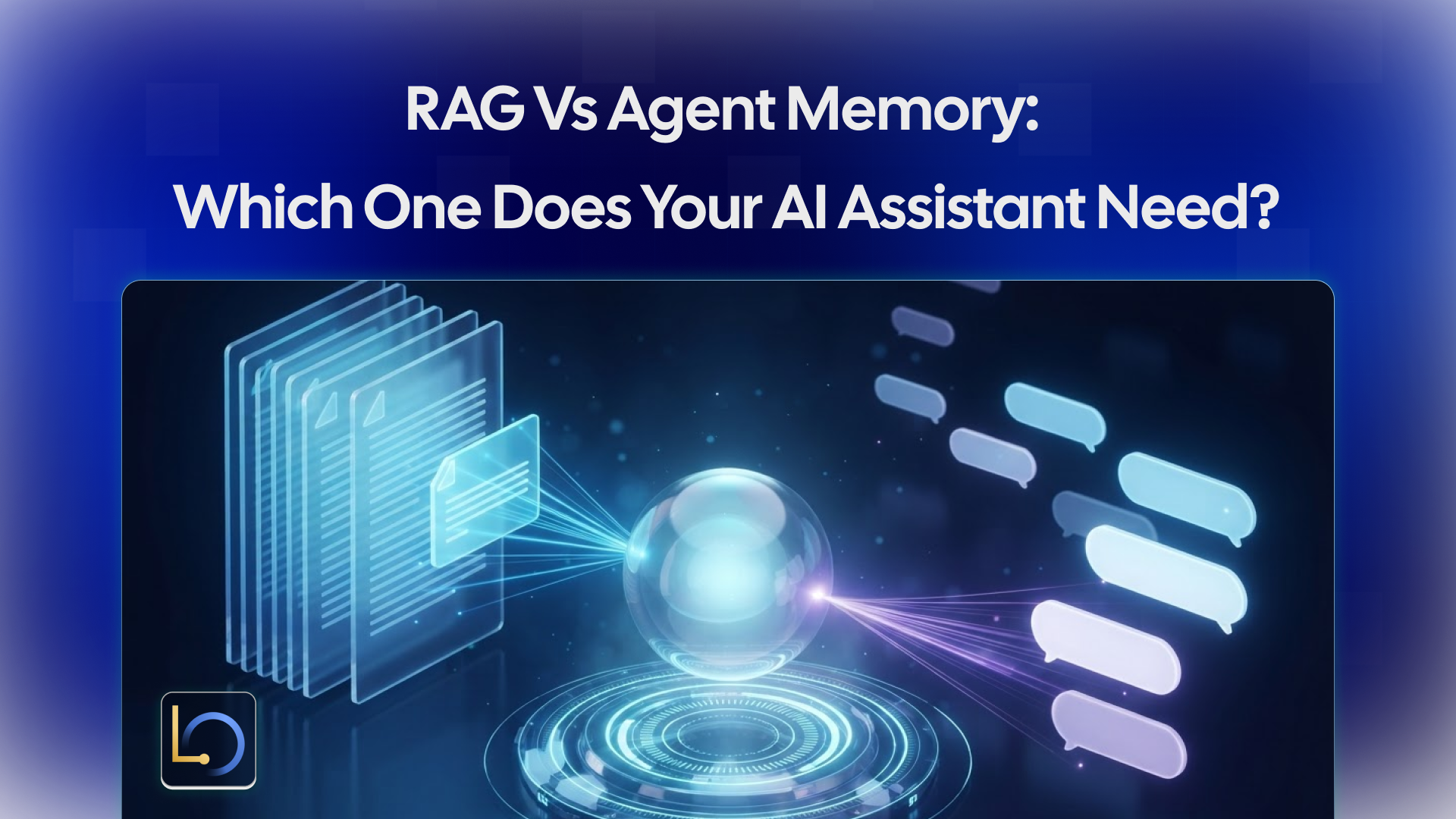
An AI assistant can know things in two different ways. It can look facts up in your documents, or it can remember what happened in earlier conversations. The first is usually called retrieval-augmented generation, or RAG. The second is agent memory.
They're often confused, and teams sometimes build one when they needed the other. An assistant that answers policy questions perfectly can still ask a returning user to repeat everything. An assistant that remembers every conversation can still invent a policy it never read. This guide explains what each one does, how they differ, and how to tell which one your assistant needs.
What RAG is
RAG lets an assistant answer from documents the model was never trained on: your policies, contracts, product docs or tickets. It works in four steps:
- Index. Documents are split into passages, and an embedding model turns each passage into a vector.
- Retrieve. When a question arrives, it's turned into a vector too, and the closest passages are found.
- Augment. Those passages are added to the prompt as context.
- Generate. The chat model answers using that context, ideally pointing to the passages it used.
RAG is about what's written down. Its source is a set of documents someone authored and maintains. The answer is only as good as those documents: if a policy is outdated, the assistant will retrieve it and answer from it faithfully.
What agent memory is
Agent memory carries context forward from earlier interactions, so the assistant doesn't start from zero every time. It can include:
- Conversation history: what was said earlier in this conversation.
- Context across sessions: facts, decisions and open threads from previous conversations about the same case or project.
- Preferences: how someone likes answers formatted, which language they use, what they've already ruled out.
- Task state: where a multi-step task stopped, so it can pick up again.
Memory is about what happened. Its source isn't a document anyone wrote; it's produced by the interactions themselves. That makes it useful for continuity and risky as a source of truth: a user's earlier statement isn't a policy, and a mistaken detail can be remembered as faithfully as a correct one.
Side by side
Which one does your assistant need?
A quick test: if the answer would be the same for everyone, it belongs in knowledge. If it depends on what this person or this case has already been through, it belongs in memory.
Using both together
Many useful assistants need both, and the split is clean when each does its own job. Take a support case where a customer writes back about a replacement shipment:
- Knowledge retrieves the shipping and credit policy, which is the same for every customer.
- Memory brings in what happened earlier on this case: what the customer was told last week and what's still open.
The reply draws on both, but they answer different questions. The policy decides what's allowed; the history decides what this customer needs to hear next.
Common mistakes
- Using memory as a knowledge base. If policies live only in past conversations, the assistant repeats whatever was said, right or wrong. Put authoritative information in documents and retrieve it.
- Using RAG for personal context. Indexing every chat transcript into a shared knowledge base can surface one person's details in another person's answer. Keep personal context in memory, with clear boundaries.
- Remembering everything. More memory isn't better memory. Decide what's worth carrying forward, and for how long, especially when conversations contain personal data.
- Never checking isolation. If memory is kept per person, test it: one user's context should not appear for another. Do this before you rely on it, not after.
- Letting knowledge go stale. RAG is only as current as its documents. Retire outdated versions and show the date or version of the source.
Knowledge and memory in LibraOS
The LibraOS Runtime treats these as two separate parts, alongside agents and control:
Because knowledge retrieval depends on an embedding model as well as a chat model, choose both when you set up your model endpoint: your own provider key, a local model server, or hosted inference.
Whichever parts you use, test them on your own workflow before launch: questions your sources can answer and questions they can't, and a returning conversation where earlier context should, and shouldn't, appear.
Conclusion
RAG answers "what do our documents say?"; memory answers "what happened before?". Use knowledge retrieval for information that's the same for everyone and lives in documents. Use memory for continuity with a person or a case. Many assistants need both, as long as each stays in its lane: authoritative facts in documents, history in memory, and clear boundaries around anything personal.
Explore LibraOS: libraos.com
Sources
What’s Next?
Sign up and explore now.
🔍 Learn more: Visit our blog and documents for more insights or contact us for a demo of how MegaNova can power your AI products.
📬 Get in touch: Join our Discord community for help or Contact Us.
Stay Connected
💻 Website: meganova.ai
📖 Docs: docs.meganova.ai
🎮 Discord: Join our Discord
👽 Reddit: r/MegaNovaAI
𝕏 X: @meganovaai