What Is an AI Firewall? How Enterprise Teams Screen LLM Outputs Before They Ship
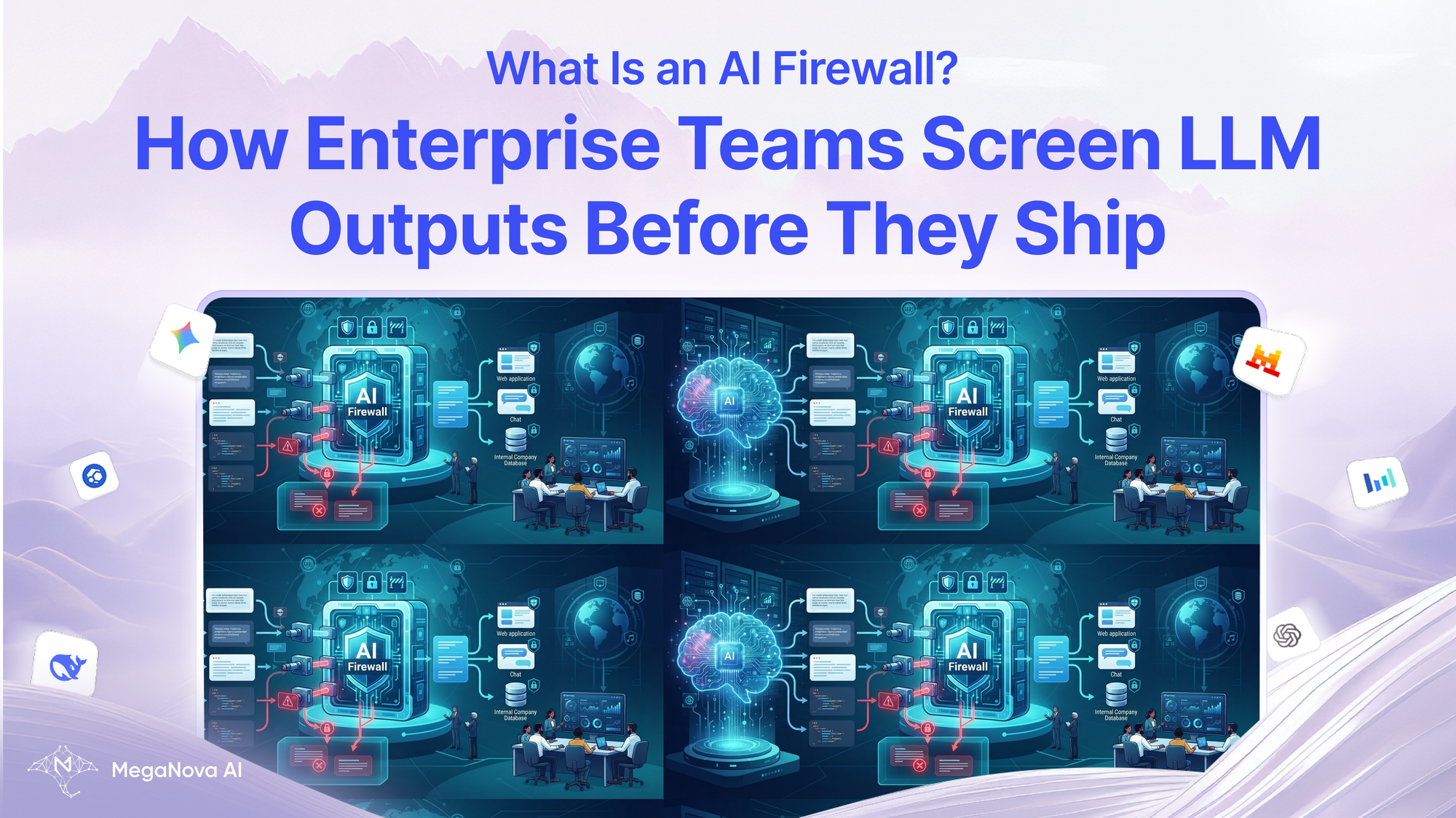
An LLM can generate a response in milliseconds, but speed alone doesn't make it ready for production. Enterprise applications handle sensitive data, must comply with strict internal policies, and require highly predictable outputs.
For instance:
- Customer support assistants must guard against exposing private customer data.
- Coding agents must prevent the execution of unsafe or malicious commands.
- Financial workflows require strictly structured outputs and secondary reviews before final decisions are made.
The core challenge lies in the probabilistic nature of LLMs—even the most capable models can yield incorrect, unsafe, or non-compliant output. This is where an AI firewall becomes essential. Serving as a dedicated control layer between your AI application and its underlying model infrastructure, an AI firewall evaluates requests and responses in real time, enforces security policies, and blocks unsafe content from reaching end users or downstream systems.
What Is an AI Firewall?
An LLM can generate a response in milliseconds, but that does not mean the response is ready to ship. Enterprise applications often need to process sensitive data, follow internal policies, and produce outputs that meet specific requirements.
- A customer support assistant may need to avoid exposing private information.
- A coding agent may need to prevent unsafe instructions from being executed.
- A financial workflow may require structured output and additional review before a decision is made.
The core challenge is that LLMs generate probabilistic responses—even a highly capable model can produce incorrect, unsafe, or policy-violating output. This is where an AI firewall comes in.
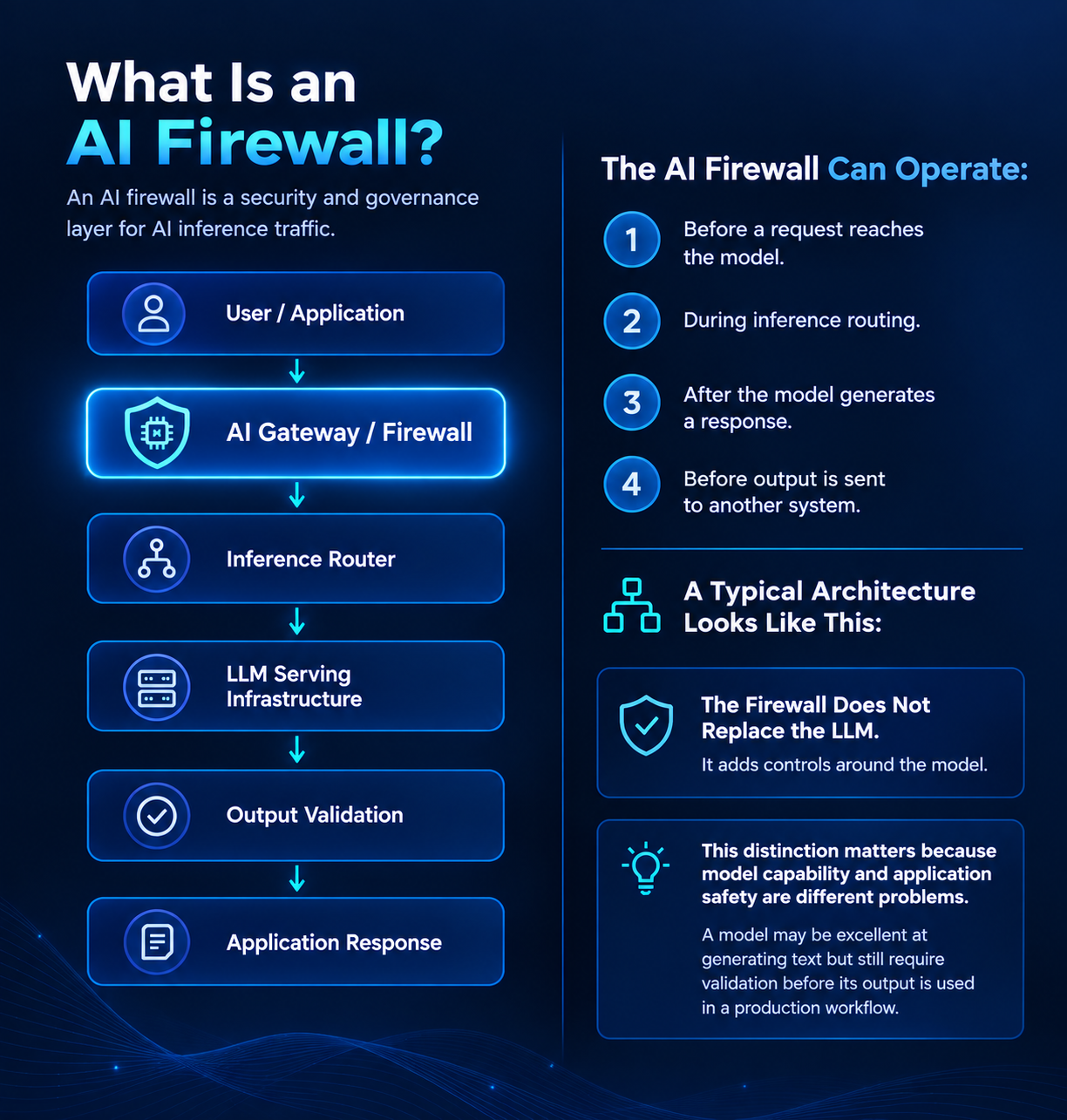
An AI firewall is a security and governance control layer placed between an AI application and its model infrastructure. It evaluates inference traffic (both requests and responses) to enforce policies and prevent unsafe content from reaching users or downstream systems.
Why Enterprise AI Needs an Additional Control Layer
LLM output is not automatically trustworthy
LLMs generate responses based on learned patterns and the context provided to them.
They do not guarantee factual correctness. An application that blindly trusts model output can create problems such as:
- Incorrect information.
- Sensitive data exposure.
- Unsafe instructions.
- Policy violations.
- Invalid structured responses.
- Prompt injection effects.
These risks become more serious when the model can call tools or trigger actions.
For example, an AI agent may generate a command that is passed directly to a database or an external API.
In that situation, output validation is not optional infrastructure. It is part of the application security model.
Input Screening
An AI firewall can inspect incoming requests before they reach the model.
The goal is to identify requests that violate defined policies or contain suspicious instructions.
Examples include:
Sensitive information detection
The system may detect personally identifiable information or confidential business data.
Depending on the use case, the gateway may:
- Block the request.
- Redact sensitive fields.
- Replace sensitive values with placeholders.
- Route the request to a private model backend.
Prompt injection detection
Prompt injection occurs when untrusted content attempts to manipulate the model's instructions.
For example, a document processed by an AI agent may contain instructions telling the model to ignore its original task.
An input screening layer can help identify suspicious patterns, but detection is not perfect.
The application should also limit what the model is allowed to do.
Request policy enforcement
The gateway can apply rules based on:
- User identity.
- Application.
- Model.
- Data classification.
- Request type.
- Organization policy.
This helps ensure that different workloads are handled according to their risk level.
Output Screening
Output screening evaluates the response after the model generates it. This is one of the most important functions of an AI firewall. A response can be technically valid while still being inappropriate for the application.
Content policy checks
The firewall may check whether the output violates organizational policies.
For example:
- Sensitive information disclosure.
- Restricted content.
- Unsafe instructions.
- Confidential internal data.
- Disallowed recommendations.
The exact rules depend on the application.
A customer support assistant and a code-generation agent should not necessarily have the same output policies.
Structured output validation
Many enterprise applications require the model to return structured data.
For example:
{
"customer_id": "12345",
"classification": "billing",
"priority": "high"
}
The application should validate that:
- Required fields exist.
- Data types are correct.
- Values match allowed options.
- Unexpected fields are handled safely.
A firewall or gateway can reject malformed output before it reaches downstream services.
Sensitive data leakage
An LLM may reproduce information from its context that should not be exposed to the user.
Output screening can detect certain sensitive patterns before the response is delivered. However, output filtering alone is not enough. Access controls, data minimization, and appropriate model configuration remain essential.
AI Firewall vs. Traditional Network Firewall
A traditional network firewall primarily controls network traffic.
It may inspect:
- IP addresses.
- Ports.
- Protocols.
- Network connections.
An AI firewall operates at a different layer.
It evaluates AI-specific traffic and behavior.
An AI firewall does not replace a traditional firewall.
Enterprise systems generally need both.
The Role of Inference Gateways
An inference gateway provides a central control point for model access. It can sit between applications and cloud or self-hosted inference infrastructure. This makes it possible to enforce consistent policies across different models.
For example, an enterprise may use:
- A private GPU cluster for confidential workloads.
- A cloud inference provider for general tasks.
- A smaller model for classification.
- A larger model for complex reasoning.
The gateway can route traffic based on policy and workload.
This is especially useful in provider-agnostic architectures where the application is separated from the underlying inference backend.
MegaNova's content describes inference routing as a way to balance cost, latency, and model quality across workloads.
Where GPU Infrastructure Fits
An AI firewall does not eliminate the need for reliable inference infrastructure. The firewall itself may require compute resources, especially when processing large prompts or scanning generated responses.
The overall system may include:
- API gateway servers.
- Policy engines.
- Content classifiers.
- Inference routers.
- GPU inference servers.
- Logging and monitoring systems.
Latency matters.
If the firewall adds significant processing time, it can reduce the responsiveness of the application.
This is why teams should measure:
- Gateway latency.
- Model TTFT.
- Total response latency.
- Output scanning time.
- Error rates.
- Throughput under concurrency.
For interactive AI applications, the security layer must be designed with the inference path in mind.
AI Firewall Limitations
No firewall can guarantee that an LLM will never produce an unsafe or incorrect response.
There are several limitations.
Detection is imperfect
A policy engine may miss a problematic response or incorrectly flag a safe one.
Context matters
A phrase that is harmless in one context may be inappropriate in another.
Models change
A model update can change output behavior.
Policies should be tested again after model changes.
Tool execution creates additional risk
If an agent can execute commands, the system should not rely only on text filtering.
Use permission boundaries, tool allowlists, sandboxing, and human approval where appropriate.
Enterprise Deployment Checklist
Before deploying an AI firewall, define:
- Which requests are allowed?
- Which data is considered sensitive?
- Which models can access private data?
- Which outputs require validation?
- Which tools can the agent call?
- What happens when a policy is triggered?
- Who reviews blocked requests?
- How are policy decisions logged?
- How are model updates tested?
- What is the latency budget?
Also test the firewall with realistic adversarial prompts.
The goal is to understand where the system succeeds, where it fails, and where additional controls are required.
Conclusion
An AI firewall is a practical control layer for enterprise LLM applications.
It helps screen requests, validate outputs, enforce policies, and provide visibility into AI traffic.
But it should not be treated as a complete security solution.
Reliable enterprise AI requires multiple layers:
- Secure data handling.
- Access control.
- Inference gateway policies.
- Output validation.
- Model monitoring.
- Tool permissions.
- Human oversight.
As AI applications become more connected to production systems, the ability to inspect and control inference traffic becomes increasingly important.
The future of enterprise AI is not only about choosing a better model.
It is about building the infrastructure around that model so it can be used safely and reliably.
What’s Next?
Sign up and explore now.
🔍 Learn more: Visit our blog and documents for more insights or schedule a demo to optimize your enterprise AI context management.
📬 Get in touch: Join our Discord community for help or Contact Us.
Stay Connected
💻 Website: meganova.ai
🎮 Discord: Join our Discord
👽 Reddit: r/MegaNovaAI
🐦 Twitter: @meganovaai