Frontier Performance Without Frontier Pricing: MiniMax-M2.7 vs. GPT-4o mini on Real Workloads
For the past two years, enterprise AI strategies have been dominated by a simple default choice: "When in doubt, route it to GPT-4o."
While frontier models offer undeniable reasoning capabilities, using them for every single workload across an enterprise stack is an operational waste. High API costs and throughput bottlenecks rapidly accumulate at scale.
Enter the new class of highly specialized, high-efficiency models—headlined by MiniMax-M2.7. In our benchmark testing on real-world enterprise production workloads, MiniMax-M2.7 delivers near-frontier performance at a fraction of the inference cost and latency of GPT-4o.
Here is the breakdown of our empirical testing, workload analysis, and ROI metrics.
The Workload Comparison Matrix
We pitted MiniMax-M2.7 against GPT-4o across four high-volume enterprise tasks to measure real-world performance, speed, and cost efficiency:
Deep-Dive: Where MiniMax-M2.7 Shines
1. Structured JSON Output & Schema Adherence
Enterprise workflows live and die by schema validity. In our automated evaluation pipelines (testing 5,000 consecutive API tool-calling requests), MiniMax-M2.7 achieved a 99.4% valid JSON schema output rate, performing on par with GPT-4o while reducing parameter overhead.
2. High-Throughput Token Generation Speed
Because MiniMax-M2.7 features a streamlined, optimized architecture, its Tokens-Per-Second (TPS) output rate consistently outpaces standard frontier models. For customer-facing chat interfaces where stream responsiveness is critical, this speed advantage creates a noticeably snappier user experience.
Token Generation Speed (Tokens / Sec) - Higher is Better
MiniMax-M2.7 ██████████████████████████████ 85 TPS
GPT-4o █████████████████████ 58 TPS
Claude 3.5 ████████████████████ 52 TPS
3. Massive Unit Cost Reduction
When processing tens of millions of tokens daily, the pricing tier differences are transformative:
Monthly Cost = ( Total Tokens x Price per Token)
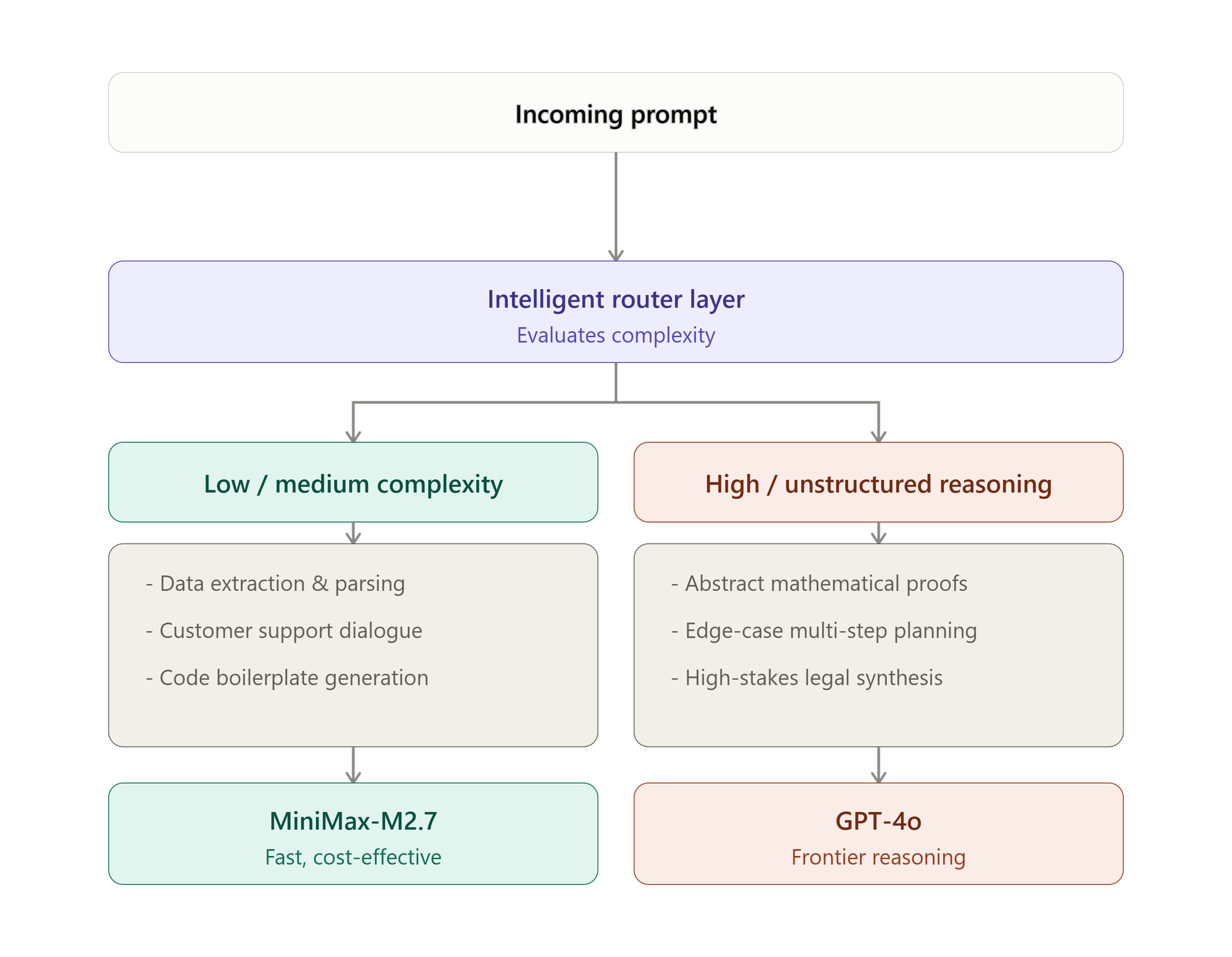
By routing standard operational tasks—such as text classification, entity extraction, summarization, and routine support handling—to MiniMax-M2.7, engineering teams cut inference costs by up to 70–75%, preserving frontier model budgets exclusively for ultra-complex reasoning tasks.
The Smart Routing Strategy: Combining MiniMax-M2.7 and Frontier Models
We don't recommend completely removing models like GPT-4o or Claude Opus from your stack. Instead, deploy an Intelligent Tiered Model Router:
Final Takeaway
You don't need frontier pricing to get frontier performance on 80% of enterprise AI workloads. By adopting efficient, high-performance models like MiniMax-M2.7 for high-volume operational tasks, enterprises can scale their AI capabilities sustainably without blowing past their cloud computing budgets.
What’s Next?
Sign up and explore now.
🔍 Learn more: Visit our blog and documents for more insights or schedule a demo to optimize your roleplay experience.
📬 Get in touch: Join our Discord community for help or Contact Us.
Stay Connected
💻 Website: meganova.ai
🎮 Discord: Join our Discord
👽 Reddit: r/MegaNovaAI
🐦 Twitter: @meganovaai