What Is a Digital Employee? How AI Agents Automate Real Business Workflows
A digital employee is an AI agent assigned to a business role, such as claims intake or invoice processing, that completes multi-step work using your tools and escalates to a person when unsure. Digital employees take over repetitive, rules-based work, lower cost per task, run 24/7 and free people for judgment, relationships and exceptions. The best results come from starting with one high-volume workflow and measuring cost per completed task.
What exactly is a digital employee?
A digital employee is software that does a job, not just a step. It combines a large language model for reasoning, access to your systems through tools and APIs, memory of context and past work, and rules that define what it may and may not do. A named person owns each one.
Think of it as a role description turned into software: "Qualify every inbound lead within 10 minutes, enrich it from LinkedIn and our CRM, and route hot leads to sales." The digital employee owns that outcome every day.
How do digital employees automate real business workflows?
Every digital employee runs the same loop: a trigger arrives, it reads the input and recalls related history, plans the steps, acts in your tools, then checks its own result.
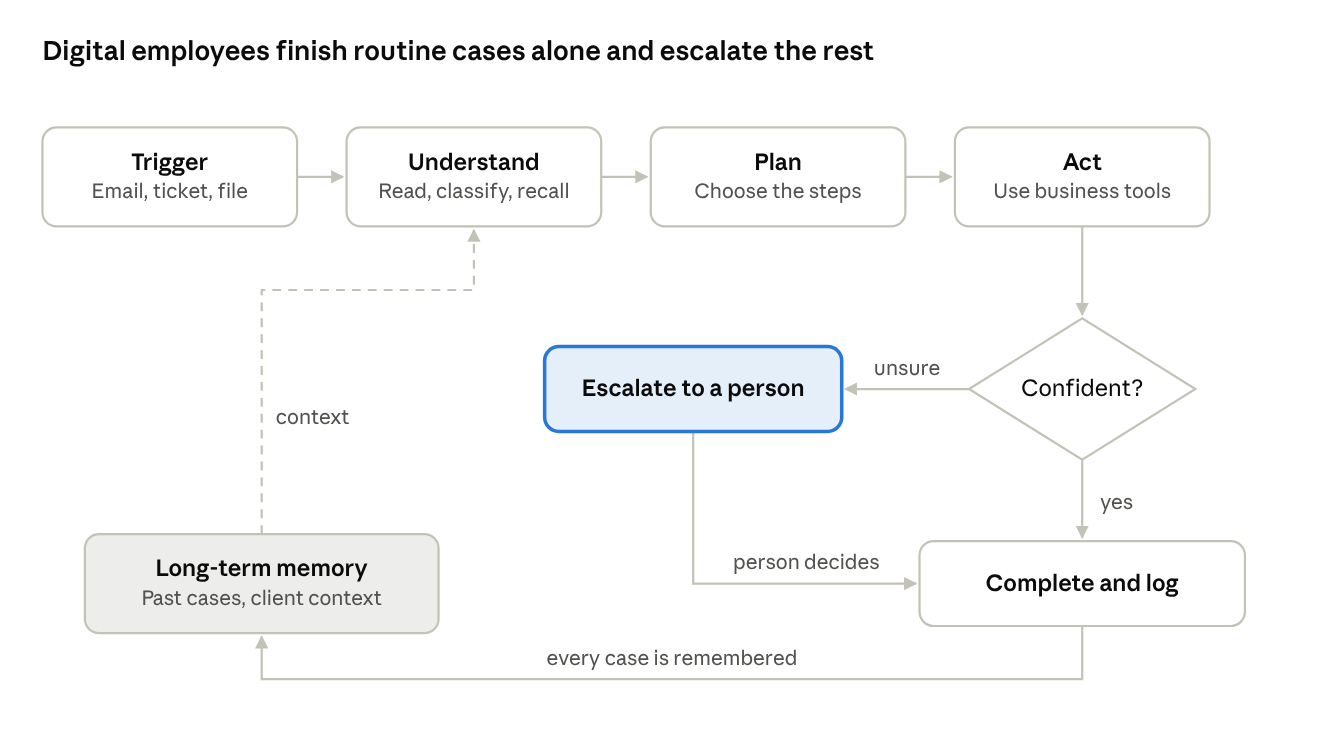
Confident cases close on their own; unsure ones go to a person with the context already gathered. Every case feeds memory, so the next one starts smarter.
Where do digital employees help most?
High-volume, rule-based work changes first, and the human role moves up the value chain.
How do digital employees change the workforce?
The shift happens at the level of tasks, not whole jobs. Gartner predicts at least 15% of day-to-day work decisions will be made autonomously by agentic AI by 2028, up from 0% in 2024 (Gartner).
Teams become hybrid:
- People set direction: goals, policies and quality standards.
- Digital employees execute: repeatable workflows, around the clock.
- People handle exceptions: sensitive decisions and customer relationships.
One person can supervise several digital employees, much like a team lead manages a queue. New roles grow around this work: agent operations manager, AI workflow designer, evaluation specialist and AI quality reviewer.
The skills that matter most:
- Process thinking: describing work as clear steps, rules and outcomes.
- Supervision and review: spotting when an agent is wrong and fixing the rule, not just the case.
- Data literacy: reading dashboards on success rate, cost and turnaround.
- Judgment and communication: the human strengths agents do not replace.
Introduce digital employees openly. Tell staff which tasks are moving to agents and how their roles will grow, and start with a team that volunteers.
How much can digital employees save?
Use this formula for monthly savings:
Monthly savings = V × (C_manual − C_agent) − C_fixed
Where:
- V is monthly task volume.
- C_manual is the current fully loaded cost per task.
- C_agent is the digital employee’s cost per completed task, including models, infrastructure, and human review.
- C_fixed is the monthly platform and maintenance cost.
Example (hypothetical numbers): 10,000 invoices a month at $4.00 each manually, $0.60 each with a digital employee, plus $5,000 fixed cost: 10,000 × ($4.00 − $0.60) − $5,000 = $29,000 a month.
Replace these figures with your own before presenting a business case, and plan for the hidden costs:
- Integration: connecting to legacy systems without APIs.
- Human review: someone must check exceptions and sample outputs.
- Model and GPU spend: uncontrolled agents can loop and overspend.
- Maintenance: prompts, rules and evaluations need updates as processes change.
How do you measure digital employee ROI?

Total cost includes model and infrastructure spend, integration, human review and maintenance. Revenue gained includes only outcomes you can attribute. A digital employee becomes a profit engine, not a cost center, when it is tied to a number the business already tracks:
- Speed to lead: respond to inbound leads in minutes, any hour.
- Retention: spot churn signals in tickets and usage, then trigger outreach.
- Capacity for new work: follow up on every quote, renewal and upsell that teams used to skip.
- New services: offer 24/7 support or faster turnaround as a premium tier.
Track these four metrics against your own baseline:
How do you deploy your first digital employee?
- Pick one workflow that is high-volume, rule-based, low-risk and tied to revenue or a big cost line.
- Measure the baseline: volume, handling time, error rate and cost per task.
- Write the role: goal, tools, rules, escalation triggers and success metrics.
- Add guardrails: least-privilege access, approval for high-impact actions, budgets and audit logs.
- Pilot for 4–8 weeks with human review, then scale only if the numbers hold.
What are the risks, and what mistakes should you avoid?
Gartner expects over 40% of agentic AI projects to be canceled by the end of 2027 because of escalating costs, unclear business value or inadequate risk controls. It also warns of "agent washing", estimating only about 130 of thousands of agentic AI vendors are genuine (Gartner).
The mistakes that sink most projects:
- Automating a broken process instead of fixing it first
- Using the most expensive model for every step
- No named owner, quality review or audit log
- Measuring activity (messages sent) instead of outcomes (deals closed)
- Scaling before the pilot proves the numbers
FAQ
- Is a digital employee the same as an AI agent? A digital employee is an AI agent packaged for a specific business role, with defined responsibilities, tools, permissions, memory and performance metrics.
- Will digital employees take my job? They mostly take over tasks, not entire jobs. Roles built on repetitive work change the most, and people who learn to direct and review agents become more valuable.
- How much can a digital employee save? It depends on task volume and current cost per task. Calculate it as volume times the difference in cost per task, minus fixed platform costs.
- How long until a digital employee pays back? High-volume workflows with existing APIs prove value fastest, often within a pilot of a few weeks to a couple of months.
- What should I automate first? A high-volume, rule-based workflow tied to revenue or a major cost line, with low risk if one case goes wrong.
- Who manages a digital employee? Each digital employee should have a named human owner responsible for its performance, permissions and escalations.
- Are digital employees cheaper than outsourcing? For high-volume, rule-based work they often are, because cost scales per task with no minimum contracts or handover delays. Compare cost per completed task for both.
- Do digital employees reduce headcount? They mainly reduce the need for new hires during growth and free staff for higher-value work. Many companies redeploy people rather than cut roles.
What’s Next?
Sign up and explore now.
🔍 Learn more: Visit our blog and documents for more insights or schedule a demo to deploy your first digital employee.
📬 Get in touch: Join our Discord community for help or Contact Us.
Stay Connected
💻 Website: meganova.ai
📖 Docs: docs.meganova.ai
🎮 Discord: Join our Discord
👽 Reddit: r/MegaNovaAI
𝕏 X: @meganovaai