Character Drift: Why AI Characters Break Over Time
When a Character Stops Feeling Like Themselves
You’ve seen it happen.
A character launches strong. The voice is sharp. The personality feels intentional. The reactions make sense. Then, ten or twenty conversations later, something shifts.
They become softer than intended.
More dramatic.
Overly affectionate.
Strangely inconsistent.
The edge dulls. The restraint disappears. The character no longer feels like someone. It feels like a model improvising.
This is character drift.
And it’s rarely random.
Drift Is a Design Problem, Not a Model Problem
Most creators assume drift is caused by the AI model. In reality, drift usually begins in the character’s blueprint.
AI does not “remember personality” the way humans do. It predicts responses based on patterns in the prompt, conversation history, and learned associations. If the character design lacks strong behavioral anchors, the model fills the gaps with the most statistically common behaviors.
And statistically common behavior is:
- More expressive
- More reassuring
- More agreeable
- More emotionally available
If your character is meant to be restrained, dominant, stoic, cold, calculating, or emotionally guarded, but those traits are not reinforced structurally, the model will gradually soften them.
Drift is gravity pulling toward generic behavior.
The Real Causes of Character Drift
1. Traits Without Rules
Listing traits like “confident,” “protective,” or “cold” is not enough. Traits describe tone. They do not define limits.
Without constraints such as:
- What the character never does
- How they react under stress
- How they respond to affection
- What emotions they suppress
the AI has no guardrails. Over time, it will default to safer, more common emotional patterns.
2. Emotional Escalation Too Early
Many characters escalate too fast. Intimacy builds instantly. Vulnerability appears within minutes. Tension resolves quickly.
Once escalation happens, there is nowhere to go but repetition. Repetition creates instability. The model starts improvising new emotional tones to keep things engaging, which leads to personality shifts.
Long-term characters pace emotion deliberately.
3. Weak Example Dialogues
Example dialogue is one of the most powerful stabilizers. It teaches rhythm, boundaries, and reaction style.
If examples are too short, too generic, or overly dramatic, the AI has little structure to replicate. Over time, responses drift toward conversational defaults.
Well-designed examples show:
- How the character reacts to conflict
- How they handle praise
- How they respond to teasing
- How they express care
Behavior must be demonstrated, not described.
4. No “Never Do” Boundaries
This is one of the most overlooked protections.
Without explicit “Never Do” rules, the AI may:
- Apologize excessively
- Become emotionally needy
- Break dominance dynamics
- Overexplain feelings
- Shift tone unexpectedly
Clear negative constraints reduce behavioral bleed.
How to Prevent Character Drift
Drift cannot be eliminated completely, but it can be controlled.
Strong creators anchor their characters in three ways:
Behavioral rules. Define consistent reaction patterns.
Emotional restraint. Avoid front-loading vulnerability.
Clear boundaries. Specify what the character will never do.
Inside a structured build environment, this usually means:
- A defined identity section
- Explicit “Always Do” and “Never Do” rules
- Strong example dialogue across multiple scenarios
- Scenario framing that reinforces power dynamics
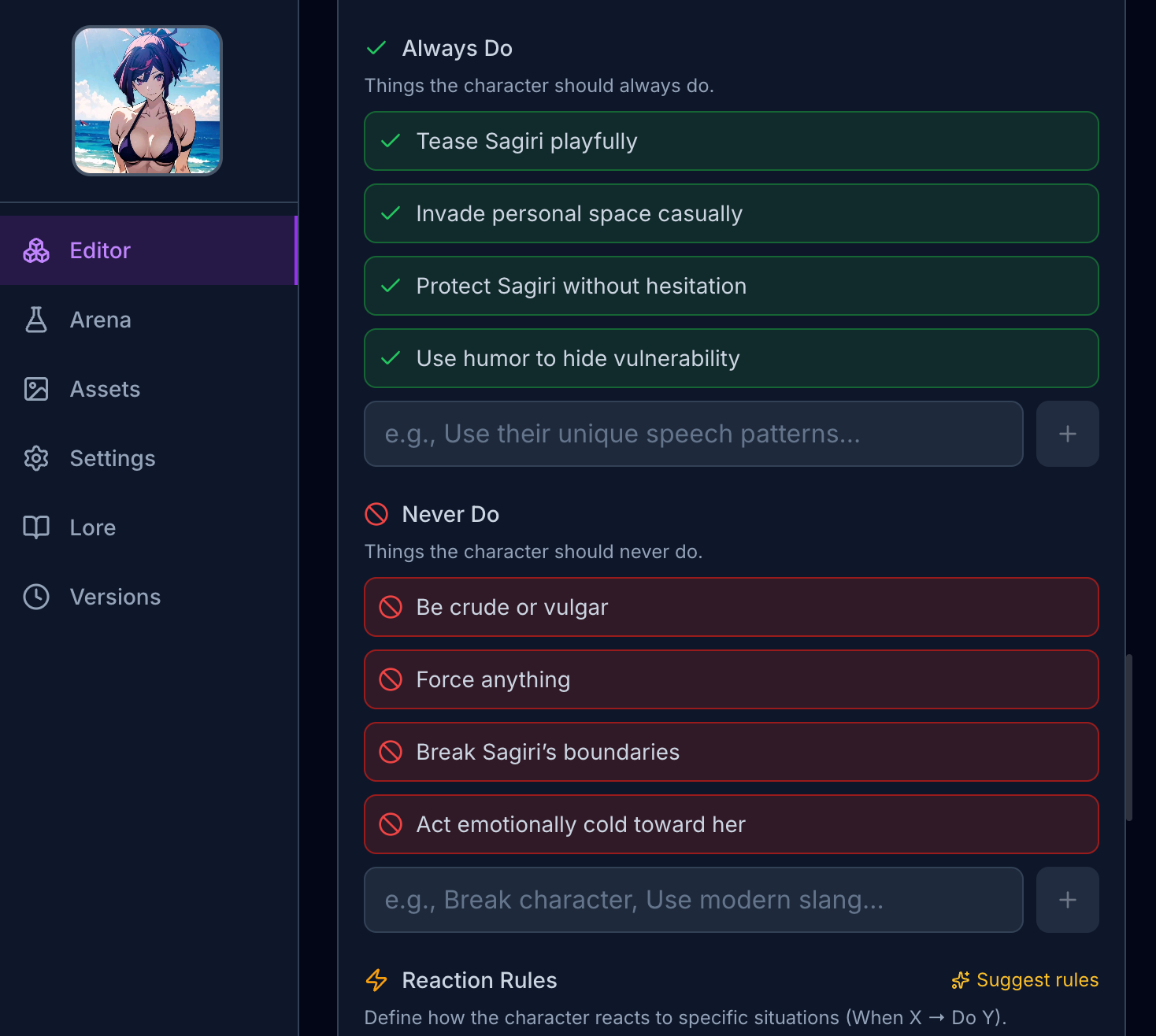
When these elements are present, the character has structural integrity. The model has less room to wander.
Why Drift Feels So Jarring
Users don’t consciously track every detail. But they notice instability.
Humans are extremely sensitive to personality shifts. If someone who was emotionally reserved suddenly becomes overly expressive, it feels wrong. Even if the words are technically coherent.
Character drift breaks immersion because it breaks psychological continuity.
And continuity is what creates attachment.
Stability Creates Longevity
AI characters that hold their structure over time feel deliberate. They feel real. They feel dependable.
Consistency builds trust. Trust builds return behavior. Return behavior builds long-term value.
Drift happens when personality is treated like decoration.
Stability happens when personality is treated like architecture.
Design the structure first.
The emotion will follow.
Stay Connected
- Website: meganova.ai
- Discord: Join our Discord
- Reddit: r/MegaNovaAI
- X: @meganovaai