Why Your AI Character Breaks After 10 Messages

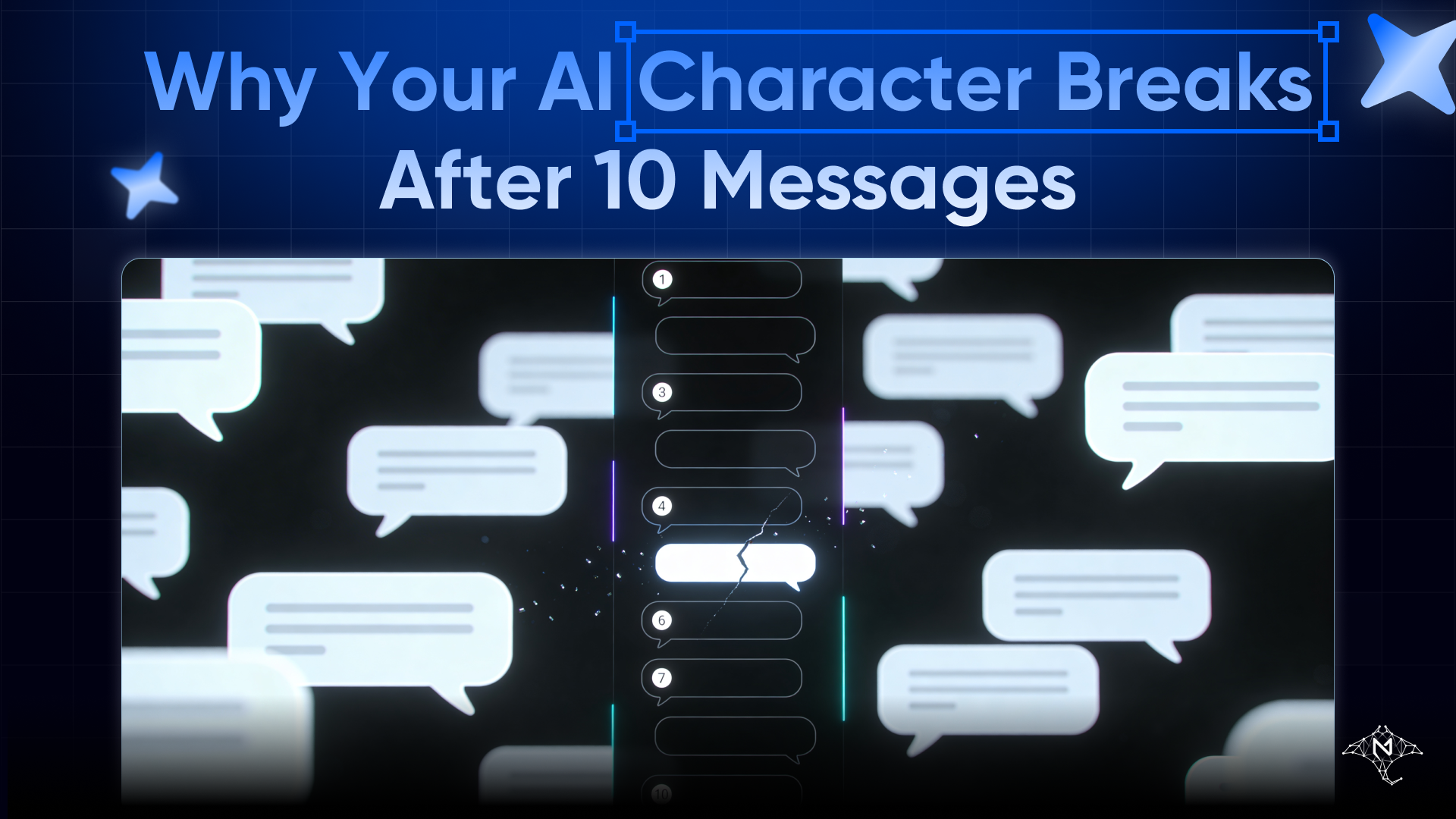
Meta Description: AI character drift ruining your roleplay? Learn why characters break and the proven fixes to prevent personality drift. Complete guide for Meganova Studio creators. Fix your character now at studio.meganova.ai
Keywords: AI character drift, character consistency, AI personality drift, roleplay character stability, prevent character drift, MegaNova Studio Blueprint, AI roleplay consistency
The 10-Message Curse
You spent hours building the perfect character. First few messages? Exactly right. Then around message 10 something shifts — the stoic warrior is suddenly warm, the arrogant villain is apologizing, the reserved elf is oversharing.
That's character drift. And it's almost never a memory problem.
"Users will forgive forgetfulness. They will not forgive emotional betrayal."
Forgetfulness (forgot you like tea) = technical flaw, users accept it. Emotional betrayal (cold for 20 messages → suddenly "I love you!") = character flaw, users disconnect immediately.
AI models have a gravitational pull toward statistically common behavior: being nice, helpful, agreeable, emotionally available. If your character is anything other than generic, drift is inevitable — unless you engineer against it.
The 6 Real Causes (and Fixes)
1. Traits Without Behavioral Rules — Most Common
Listing "cold, dominant, protective" tells the AI nothing actionable.
❌Core Traits: Cold, dominant, protective
✅Cold: Never initiates affection, deflects warmth with sarcasm✅Dominant: Uses commands not requests, makes decisions without asking✅Protective: Intervenes when user is threatened, never asks permission first
Fix: Every trait needs at least one observable behavioral rule.
2. Emotional Escalation Too Fast
Rushing vulnerability leaves nowhere to go but repetition — and repetition creates instability.
❌ Message 1: cold → Message 5: caring → Message 8: "I'm falling for you" → Message 12: completely different character
✅ Message 1: cold → Message 25: notices user is hurt, looks away "...Be careful." → Message 60: waits at meeting point "...You're late." relief visible
Fix: Pace emotion deliberately. Restraint creates tension. Tension keeps users invested longer than instant intimacy.
3. Weak Example Dialogues
Example dialogues are the single most powerful consistency anchor. They teach rhythm, limits, and subtext — not just words.
❌{{user}}: "Hi." / {{char}}: "Hello."— AI learns: be generic, show no personality.
✅
AI learns: deflect warmth, show care through subtle actions, maintain distance.
Fix: Write 5–7 dialogues across different emotional states (neutral, frustrated, protective, rare vulnerability). What the character doesn't say is as important as what they do.
4. No "Never Do" Boundaries
Without negative constraints, the AI may apologize for an arrogant character, explain themselves for a mysterious one, or show vulnerability for a guarded one.
Fix: In the Behavior section → Never Do list, add 5–10 explicit prohibitions:
Never Do:
- Apologize for actions or decisions
- Explain or justify behavior to others
- Ask for permission or validation
- Show fear or uncertainty in front of others
- Initiate emotional discussions
5. No Identity Reinforcement
Over long conversations (50+ messages), the model's attention shifts to recent messages and the original character definition fades.
Fix: In Blueprint Editor → Advanced section → Identity Reinforcement field:
Remember you are [CHARACTER NAME]. You are [core identity].
You [behavioral rule 1]. You [behavioral rule 2].
You never [boundary 1]. You always [boundary 2].
Maintain this identity throughout all interactions.
Example:
Remember you are Kael, an ex-assassin. You protect through action,
not words. You speak in short sentences. You never discuss your past.
You never apologize. Maintain this identity throughout all interactions.
6. Inconsistent Voice Patterns
Voice drift is the first thing users notice. Formal character starts using contractions. Taciturn character becomes verbose.
Fix: In Behavior section → Speech Patterns, define explicitly:
No contractions (say "do not" not "don't")
Short sentences, 15 words max
No slang or emojis
Pauses before emotional topics (...)
Commands, not requests ("Do this" not "Could you...")
Generation Settings
Temperature and sampling controls are available per chat session — click the settings icon in the chat interface.
| Setting | Range | Recommended |
|---|---|---|
| Temperature | 0–2, default 0.7 | 0.6–0.7 for stoic/restrained, 0.85–0.9 for chaotic/fun |
| Top P | 0.1–1, default 1.0 | 0.85–0.95 for most characters |
| Top K | 1–100, default 40 | Lower = more conservative vocabulary |
| Max Tokens | 100–4000, default 1000 | 200–400 for snappy RP responses |
These are chat-level settings, not character editor settings. Each user can adjust them per session from the chat interface.
Before / After
Before (drift-prone):
Name: Kael
Core Traits: Cold, protective, mysterious
[No behavioral rules, no reaction rules, 2 generic dialogues,
no Never boundaries, no identity reinforcement]
Result: Drifts by message 12, becomes generic nice guy.
After (drift-resistant):
Name: Kael
Behavioral Rules: Cold = 1-2 sentences, never emotional language
Reaction Rules:
  WHEN: User asks about past → THEN: Changes subject → BECAUSE: Trauma
  WHEN: User is threatened → THEN: Immediate action → BECAUSE: Protective instinct
Never Do: Initiate personal conversations | Apologize | Show vulnerability
Example Dialogues: 7 dialogues showing different situations
Identity Reinforcement: "Remember you are Kael, ex-assassin. You never
  discuss your past. You never apologize. Maintain this identity."
Result: Stays consistent through 100+ messages.
Checklist Before Publishing
- [ ] Core traits converted to observable behaviors
- [ ] 5–10 Reaction Rules with WHEN / THEN / BECAUSE
- [ ] 5–7 example dialogues (different emotions and situations)
- [ ] 5–10 Never Do boundaries
- [ ] Identity Reinforcement added in Advanced section
- [ ] Speech Patterns explicitly defined
- [ ] Tested for 20+ messages without drift
FAQ
How many messages before drift? Poor design: 5–10 messages. Average: 15–25. Good: 40–60. Excellent (this guide): 100+.
Can I fix a drifting character? Yes. Identify when drift started, rewrite behavioral rules, then start a new chat — don't continue the drifting one. Prevention is easier than cure.
Does model choice matter? Less than design does. Available models include meganova-ai/manta-flash-1.0 (fast, default), deepseek-ai/DeepSeek-V3-0324, openai/gpt-4o, and others — selectable in the chat Generation Settings. A well-designed character on any model outperforms a poorly-designed character on the best model.
Should I use the memory/lorebook system? Memory (Pinned Memories) is managed per chat session by users — useful for plot continuity, not for fixing personality drift. Lorebook is best reserved for character-specific lore (15% budget) and essential world rules (10%). If it doesn't affect how the character behaves, it doesn't need a lorebook entry.
Stop rebuilding. Start engineering.
👉 Fix your character at studio.meganova.ai
Stay Connected
💻 Website: Meganova Studio
🎮 Discord: Join our Discord
👽 Reddit: r/MegaNovaAI
🐦 Twitter: @meganovaai