What Is AI Data Sovereignty? Why Healthcare & Finance Need On-Premise Models
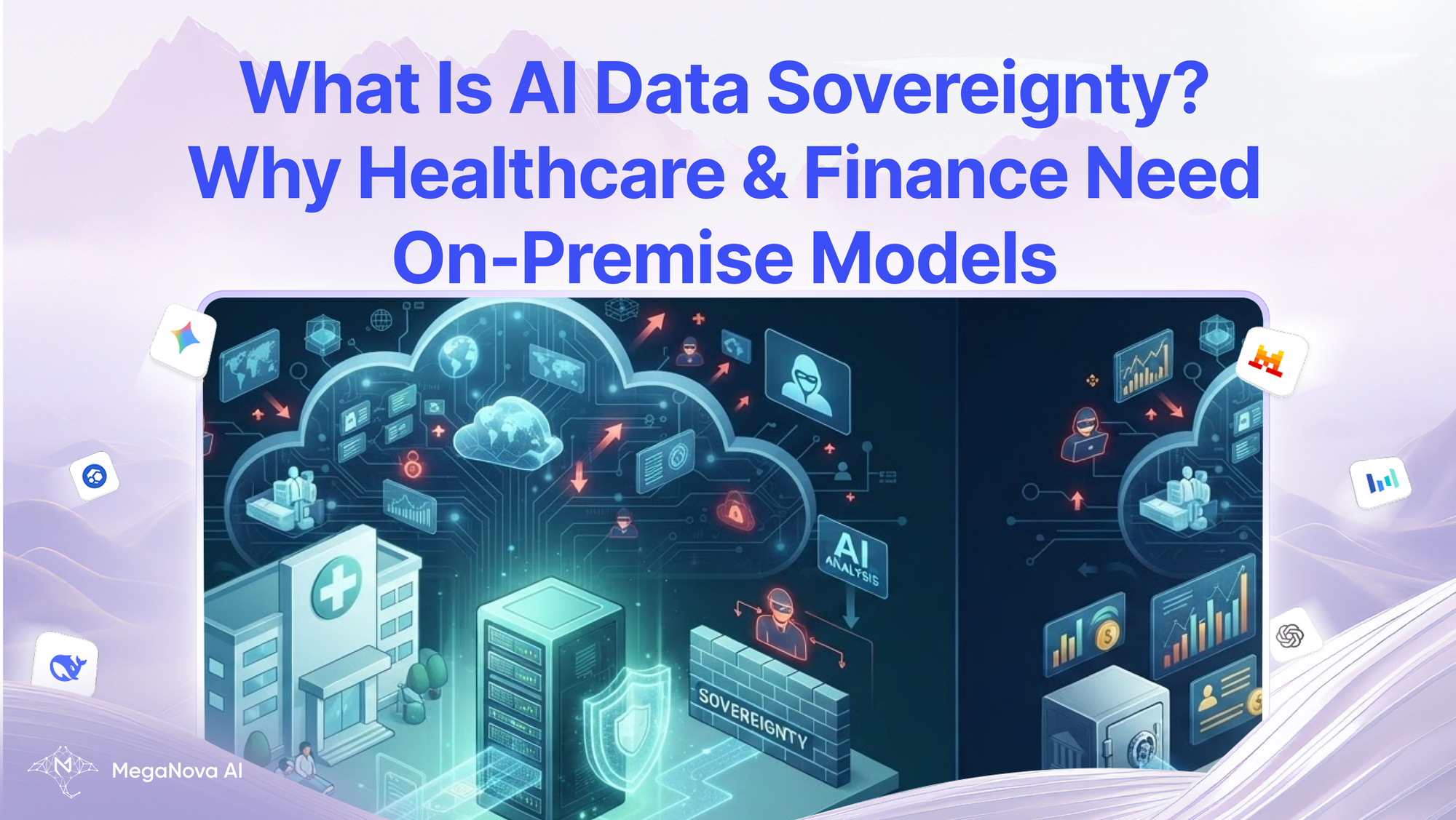
"Data sovereignty" used to mean a straightforward question: which country's laws govern your data? In the age of AI, the question has expanded. It's no longer just about where data is stored — it's about where it's processed, which third parties' infrastructure it touches during inference, and whether a foreign jurisdiction's legal system can compel access to it, even indirectly.
For healthcare and finance — two of the most heavily regulated sectors — this expanded definition of data sovereignty is becoming a deployment requirement, not a nice-to-have.
Defining AI Data Sovereignty
AI data sovereignty is the principle that an organization's data — and the AI models processing it — remain under the legal and operational control of a specific jurisdiction, and are not subject to unauthorized access, transfer, or processing outside that boundary. It covers several distinct layers:
- Storage sovereignty — where data physically resides
- Processing sovereignty — where and by whom the data is computed on, including during model inference
- Operational sovereignty — who can access, modify, or export the underlying models and infrastructure
- Legal sovereignty — which jurisdiction's laws apply to the entities operating the infrastructure, including foreign legal-access statutes that can apply even to data physically stored elsewhere
The critical shift with generative AI is that processing sovereignty now matters as much as storage sovereignty. Sending a prompt containing sensitive data to a third-party API — even one hosted in the "right" country — can still traverse infrastructure operated by an entity subject to a different jurisdiction's legal reach.
Why This Is Different from Traditional Data Residency
Traditional data residency rules were built around databases: keep the records in a specific region, and compliance follows. LLM-based systems break that model in a few specific ways:
- Prompts often contain more sensitive context than a structured database query — full documents, patient histories, or transaction narratives get pasted directly into prompts.
- Model providers may log, cache, or use inputs for purposes like abuse monitoring or model improvement, depending on their terms of service, creating a secondary data flow beyond the original request.
- Sub-processors and infrastructure partners are often several layers removed from the visible API provider, making it harder to map the full data flow.
- Model weights themselves can become a compliance concern if fine-tuned on sensitive data, since the resulting model may need to be treated as a regulated asset in its own right.
Why Healthcare Needs On-Premise or Sovereign Models
Healthcare data is subject to some of the strictest handling requirements of any data category — patient records, diagnostic information, and treatment histories are protected under regulations like HIPAA in the US and equivalent frameworks elsewhere. Beyond the letter of the regulation, healthcare organizations face a practical reality: a data breach or improper disclosure involving patient information carries reputational and legal consequences that are difficult to fully insure against.
On-premise or sovereign-cloud LLM deployment gives healthcare organizations:
- Direct control over which infrastructure ever sees protected health information
- The ability to demonstrate, with architecture diagrams and access logs, exactly where data flows
- Elimination of dependency on a third-party provider's own compliance posture and sub-processor list
- The ability to keep model fine-tuning and retrieval data entirely within an already-audited compliance boundary
Why Finance Needs the Same Guarantees
Financial institutions face a parallel set of pressures: regulatory requirements around data localization, restrictions on cross-border transfer of material non-public information, and internal risk controls that treat "where does our data go" as a first-class question for any new technology. Trading strategies, client portfolios, and transaction data are exactly the kind of information that should never depend on trust in an external provider's internal access controls.
On-premise or sovereign AI deployment lets financial institutions apply the same infrastructure controls they already use for core banking and trading systems to their AI workloads — rather than carving out an exception for AI that undermines an otherwise strict compliance posture.
What "On-Premise" Actually Requires
Achieving genuine data sovereignty with self-hosted models isn't just installing an open-source model on internal servers. It requires:
- A serving infrastructure with no default outbound telemetry to third parties
- Access controls and audit logging equivalent to existing regulated systems
- Clear model provenance and version control
- A defined process for evaluating and approving any model updates before they touch production data
- Documented data flow diagrams that can be presented during a regulatory review
Conclusion
AI data sovereignty extends the traditional data residency question into the processing layer, and that shift matters most where the data is most sensitive. For healthcare and finance, on-premise or sovereign-cloud model deployment isn't about avoiding AI adoption — it's about adopting it in a way that keeps data control where it has always needed to be: inside a boundary the organization itself can see, audit, and defend.
What’s Next?
Sign up and explore now.
🔍 Learn more: Visit our blog and documents for more insights or schedule a demo to optimize your enterprise AI context management.
📬 Get in touch: Join our Discord community for help or Contact Us.
Stay Connected
💻 Website: meganova.ai
🎮 Discord: Join our Discord
👽 Reddit: r/MegaNovaAI
🐦 Twitter: @meganovaai