What Is a Dependency Graph in AI Workflows? A Plain-English Explainer
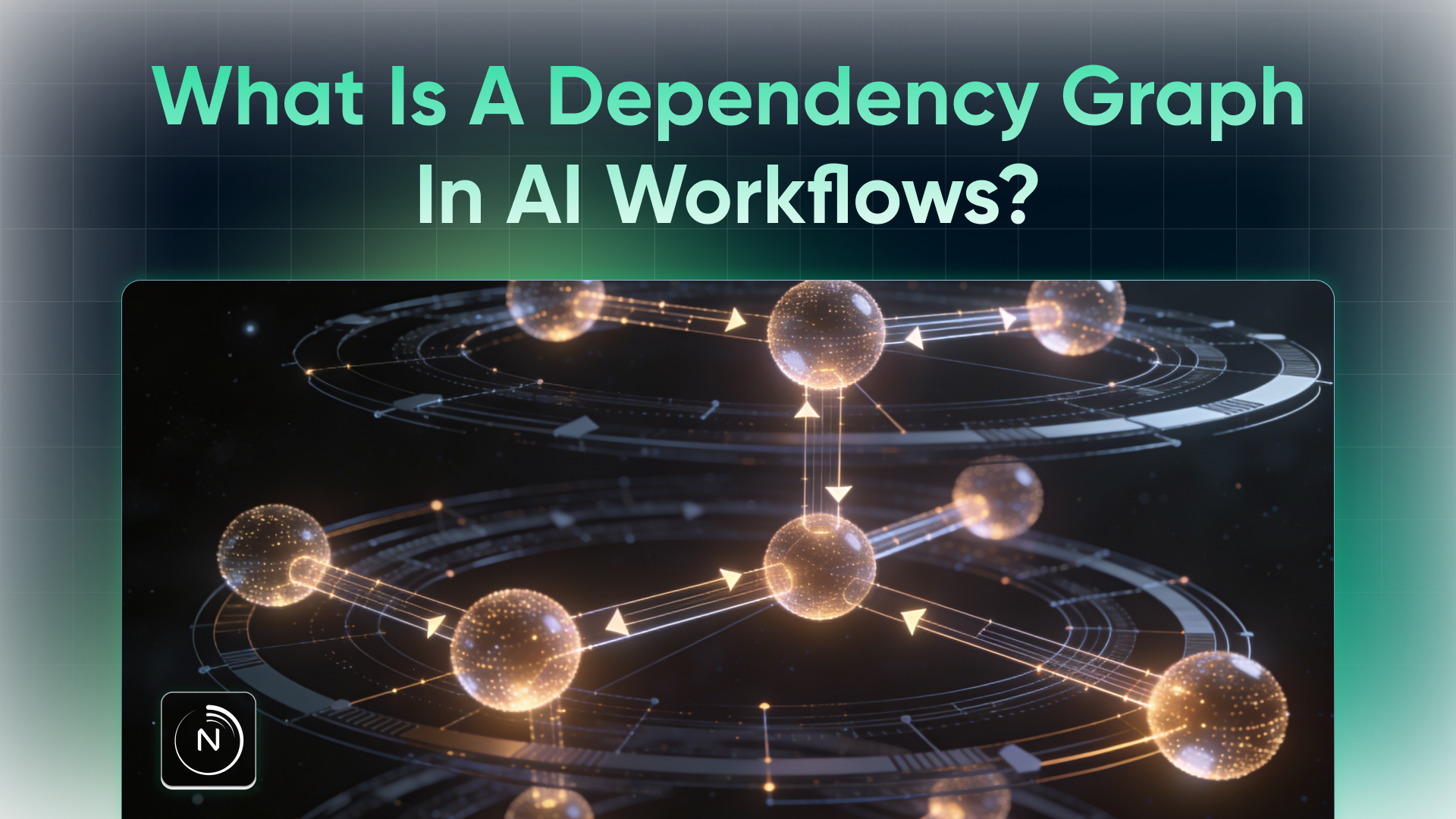
Note: A dependency graph is the visual and structural blueprint of your agent's decision-making process. It tells NovaBrain not just what tasks to perform, but in what order to perform them to ensure logical consistency and parallel efficiency.
Overview
In simple chatbot systems, AI tasks are linear: a user asks, and the AI answers. However, enterprise-grade AI workflows—such as analyzing contracts or compiling market research—require multi-step processes where the output of one task is the input for the next.
A Dependency Graph (technically a Directed Acyclic Graph or DAG) is the logical map that prevents an agent from trying to "serve the meal before the ingredients are chopped." It enforces a strict order of operations, ensuring that dependent tasks wait for their prerequisites to complete, while independent tasks execute in parallel.
Workflow Evolution: Linear vs. Graph
| Feature | Linear Workflow (Legacy Chatbot) | Graph Workflow (Nova OS) |
| Execution | Sequential (One after another) | Parallel (Concurrent execution) |
| Complexity | Simple FAQs | Enterprise-grade automation |
| Bottlenecks | High (Waiting for step-by-step) | Low (Non-dependent tasks run simultaneously) |
| Failure State | Chain reaction crash | Isolated node failure (with circuit breakers) |
The Core Concept: Nodes and Edges
In the MegaNova architecture, your workflow is composed of two fundamental elements:
- Nodes: These are the individual tasks (e.g., "Search Web," "Fetch URL," "Summarize PDF," "Draft Report"). Each node represents a discrete unit of work performed by a specialized agent.
- Edges: These are the dependencies that connect the nodes. An edge from "Search Web" to "Summarize PDF" tells NovaBrain that the search results must be successfully retrieved before the summarization agent can begin its work.
Why "Acyclic"?
In a production AI workflow, your graph must be acyclic (it cannot loop back on itself indefinitely). If your graph has a loop, your agent will enter an infinite "thought loop," consuming credits without producing a final result, and ultimately breaking character immersion.
Benchmark Impact: The "Agency" Dimension
Within the Character Studio Quality Panel, the structure of your dependency graph directly affects your Agency and Stress scores:
- Agency (High): When your graph clearly maps dependencies, the agent "knows" exactly what it has, what it needs, and what its next step is. This allows the agent to drive the conversation toward a goal without checking in with the user for basic instructions.
- Stress (High): If your dependency graph is poorly defined (e.g., missing edges), the agent may attempt to process tasks without necessary data. This triggers the Circuit Breakers in Nova OS, causing the agent to stall or error out when handling edge cases.
Implementation & Optimization Logic
To build efficient workflows, configure your graphs to maximize parallelism.
| Logic Issue | Instead of... | Use... |
| Blocking Paths | Making "Agent A" wait for "Agent B" unnecessarily. | Defining independent branches in the graph to run tasks in parallel. |
| Data Flow | passing large payloads between all nodes. | Passing only the output (e.g., specific JSON keys) from one node to the next. |
| Decision Trees | Hard-coding fixed flows. | Implementing conditional logic (Edges that only trigger if the previous node returns a specific status). |
| Query Grouping | Ignoring the X-Request-Group-Id. | Wrapping all sub-calls in a single Group-Id to maintain the graph execution context. |
Next Steps: Architect Your Workflow
Ready to architect your workflow?
Sign up and leverage the Nova OS Task Engine to build more capable, autonomous agents that utilize graph-based planning.
🔍 Learn more: Visit our blog and documents for more insights or schedule a demo to optimize your roleplay experience.
📬 Get in touch: Join our Discord community for help or Contact Us.
Stay Connected
💻 Website: meganova.ai
🎮 Discord: Join our Discord
👽 Reddit: r/MegaNovaAI
🐦 Twitter: @meganovaai