Routing Accuracy vs. Output Quality: What Actually Matters in Agent Benchmarks
In the world of AI benchmark leaderboards, numbers reign supreme. Engineers chase high scores on MMLU, HumanEval, and GSM8K to prove their agents are "smarter." But as enterprise teams move multi-agent frameworks into production, a glaring disconnect emerges: high benchmark scores on output quality do not guarantee reliable real-world performance.
When an AI agent fails in production, it is rarely because it didn't know how to write an eloquent summary. It fails because it invoked the wrong API tool, passed malformed parameters, or got stuck in a routing loop.
To build reliable enterprise agents, we must separate - and re-prioritize - Routing Accuracy versus Output Quality.
Understanding the Split
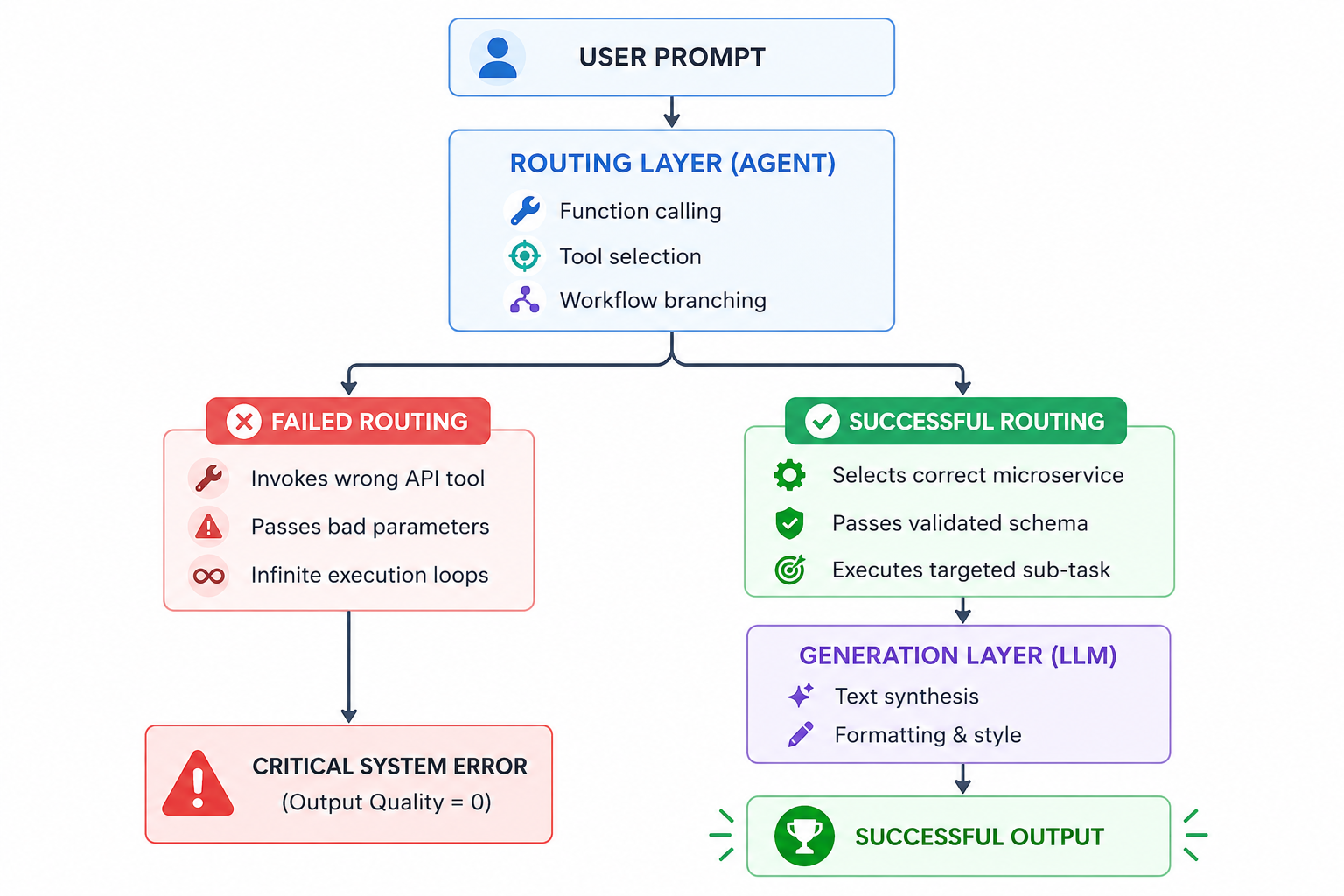
- Routing Accuracy (The Control Plane): The agent's ability to evaluate user intent, select the correct tool or sub-agent, supply valid JSON parameters, and proceed through a execution graph without breaking.
- Output Quality (The Data Plane): The fluency, nuance, domain accuracy, and stylistic coherence of the text or code generated by the model once the correct context has been assembled.
Why Benchmarks Mislead Enterprise Teams
Standard LLM benchmarks treat model evaluation as a single-step completion problem. They supply a prompt with all necessary context baked in, then grade the final output.
Real-world agents, however, operate as multi-step state machines. A failure at the routing layer propagates downstream:
- The Hallucination Cascade: If a routing agent selects the wrong database tool, it feeds bad retrieval data to the downstream LLM. Even if that downstream model has world-class "Output Quality," it will eloquently synthesize completely incorrect conclusions.
- Deterministic Brittle Failure: If a routing agent outputs {"user_id": "1234"} instead of {"userId": 1234}, the downstream API call throws a 400 error. Output quality instantly drops to zero because the system crashes before text generation even begins.
What Actually Matters in Agent Benchmarks
If you want to benchmark an agent system for enterprise readiness, measure these three operational metrics:
1. Schema Adherence Rate (SAR)
Does the model output strictly valid parameters matching your OpenAPI/JSON schemas across 1,000 edge-case runs? A model with slightly lower writing style scores but a 99.9% SAR is vastly superior to a brilliant model that fails schema validation 5% of the time.
2. Decision Tree Depth Efficiency
How many intermediate tool calls does the agent make to solve a problem? An agent that solves a task in 3 targeted tool calls is cheaper, faster, and far more reliable than one that wanders through 12 reasoning loops to reach the same destination.
3. Error Recovery Rate (ERR)
When a tool returns a 500 Server Error or invalid payload, does the routing agent recognize the error state and pivot gracefully (e.g., trying a fallback tool or adjusting parameters), or does it endlessly retry until it hits execution timeouts?
The Architecture Rule
Output Quality is a luxury; Routing Accuracy is a prerequisite.
When designing multi-agent workflows, decouple these responsibilities. Use small, fast, highly-fine-tuned routing models optimized strictly for schema adherence and tool selection, and save your high-parameter, high-output-quality models for the final synthesis layer.
What’s Next?
Sign up and explore now.
🔍 Learn more: Visit our blog and documents for more insights or schedule a demo to optimize your roleplay experience.
📬 Get in touch: Join our Discord community for help or Contact Us.
Stay Connected
💻 Website: meganova.ai
🎮 Discord: Join our Discord
👽 Reddit: r/MegaNovaAI
🐦 Twitter: @meganovaai