Provider Agnosticism in AI: Supporting OpenAI, Anthropic, and Gemini Behind One Interface
The enterprise AI landscape moves at breakneck speed. A model that leads in reasoning today might be surpassed in speed, price, or context handling by a competitor tomorrow. Yet, many organizations remain trapped in vendor lock-in—their codebases deeply tightly-coupled to proprietary SDKs like openai or anthropic.
When your application code directly imports provider-specific SDKs, changing models requires refactoring prompt templates, rewriting function calling definitions, rehandling rate limits, and modifying payload schemas.
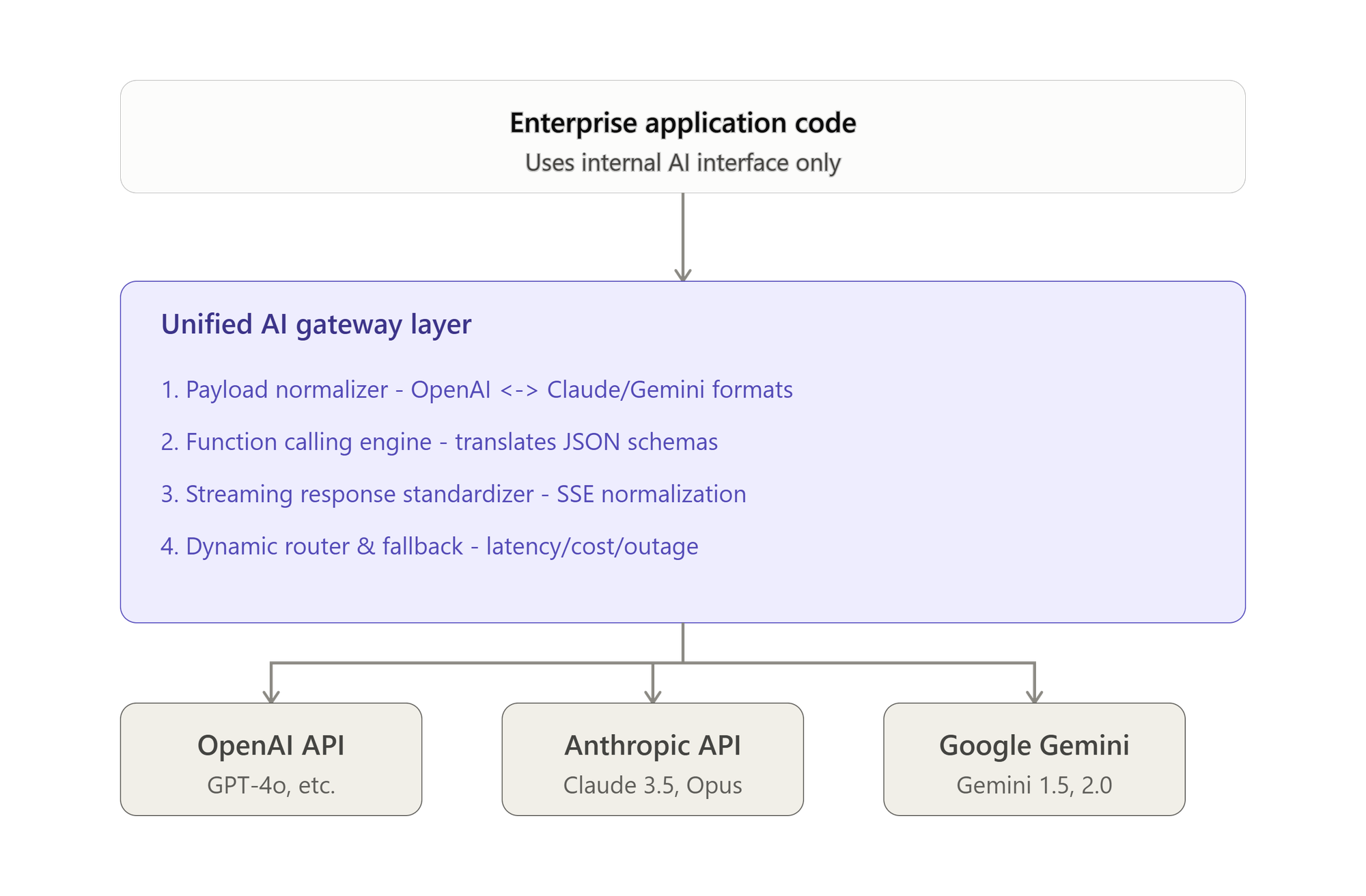
True enterprise resilience requires Provider Agnosticism: building an abstraction layer that unifies OpenAI, Anthropic, Google Gemini, and open-source endpoints behind a single, internal interface.
The Anatomy of an Un-Opinionated AI Gateway
To support any LLM provider seamlessly, your abstraction layer must handle four core normalization tasks:
1. Payload & Request Normalization
Providers structure requests differently. OpenAI uses a flat array of messages (system, user, assistant). Anthropic requires system prompts as a top-level parameter separate from the messages array. Gemini uses contents with parts objects and role: "model" instead of "assistant".
Your proxy gateway must accept a single, standardized internal payload (typically conforming to the OpenAI-compatible specification) and translate it on-the-fly to the destination provider's expected JSON format.
2. Universal Function Calling Abstraction
Tool calling syntax is notoriously fragmented across providers:
- OpenAI: Uses tools: [{type: "function", function: {...}}] and returns tool_calls.
- Anthropic: Uses tools: [{name: ..., input_schema: {...}}] and returns tool_use blocks embedded inside text content arrays.
- Gemini: Uses tools: [{function_declarations: [...]}] and returns functionCall.
A provider-agnostic interface exposes one single schema format (e.g., standard JSON Schema) to internal developers. The proxy layer handles parsing, translation, and response extraction, shielding downstream applications from provider-specific structural quirks.
3. Standardized Streaming Mechanics
Real-time user experiences require Server-Sent Events (SSE). However, reading delta streams from OpenAI (choices[0].delta.content) differs wildly from Anthropic's event-type stream (content_block_delta) or Gemini's response chunks. The proxy layer re-packs these incoming streams into a standardized event stream before piping them to the client interface.
The Business Advantages of Provider Agnosticism
- Zero-Downtime Multi-Region Fallbacks: If OpenAI experiences an outage or elevated 503 error rates, your gateway automatically reroutes traffic to Claude or Gemini in sub-second time without customer intervention.
- Cost Optimization via Dynamic Model Routing: Simple tasks (like text classification) can automatically be routed to low-cost models, while high-complexity prompts route to frontier models—slashing monthly inference bills.
- Instant Capability Adoption: When a provider releases a new breakthrough model, your team can start leveraging it across all production services immediately by updating a single configuration flag at the gateway layer.
What’s Next?
Sign up and explore now.
🔍 Learn more: Visit our blog and documents for more insights or schedule a demo to optimize your roleplay experience.
📬 Get in touch: Join our Discord community for help or Contact Us.
Stay Connected
💻 Website: meganova.ai
📖 Docs: docs.meganova.ai
🎮 Discord: Join our Discord
👽 Reddit: r/MegaNovaAI
𝕏 X: @meganovaai