How Context Windows Break Under Enterprise Load — and How We Engineered Around It
The arrival of 1-million+ token context windows was hailed as the death of Retrieval-Augmented Generation (RAG). Prompts like "Just drop the entire 800-page codebase into the context window" became common advice.
However, moving from single-user experiments to enterprise-scale production load reveals a harsh truth: massive context windows break down quickly under real-world performance requirements.
Relying on giant context payloads introduces three crippling bottlenecks: latency spikes, economic inefficiency, and attention degradation. Here is how context windows break at scale—and the architectural patterns engineered to solve them.
The Three Context Failure Modes Under Load
- "Lost in the Middle" Attention Degradation Attention mechanisms inside Transformer models are not uniformly precise across vast context windows. Research and empirical testing prove that LLMs attend exceptionally well to tokens placed at the very beginning and end of a prompt, but accuracy dips significantly when retrieving specific information buried in the middle 60%.
- Quadratic/Linear Latency Inflation Time to First Token (TTFT) scales directly with context length. Processing a 200,000-token prompt can cause pre-fill processing times to jump from 400ms to over 8–15 seconds per request. For interactive enterprise applications, this delay destroys the user experience.
- The Exponential Cost Curve API pricing scales linearly with token input size. If every turn of a customer support conversation resends a cumulative 50,000-token context history, transaction costs compound rapidly:
Total Tokens = Σ (H_k + U_k)
(Where H_k is the growing conversation history at turn k, and U_k is the new user prompt).
The 4-Layer Context Management Engine
To maintain sub-second response times and high accuracy under enterprise load, an active context management pipeline must be implemented between the application and the LLM:
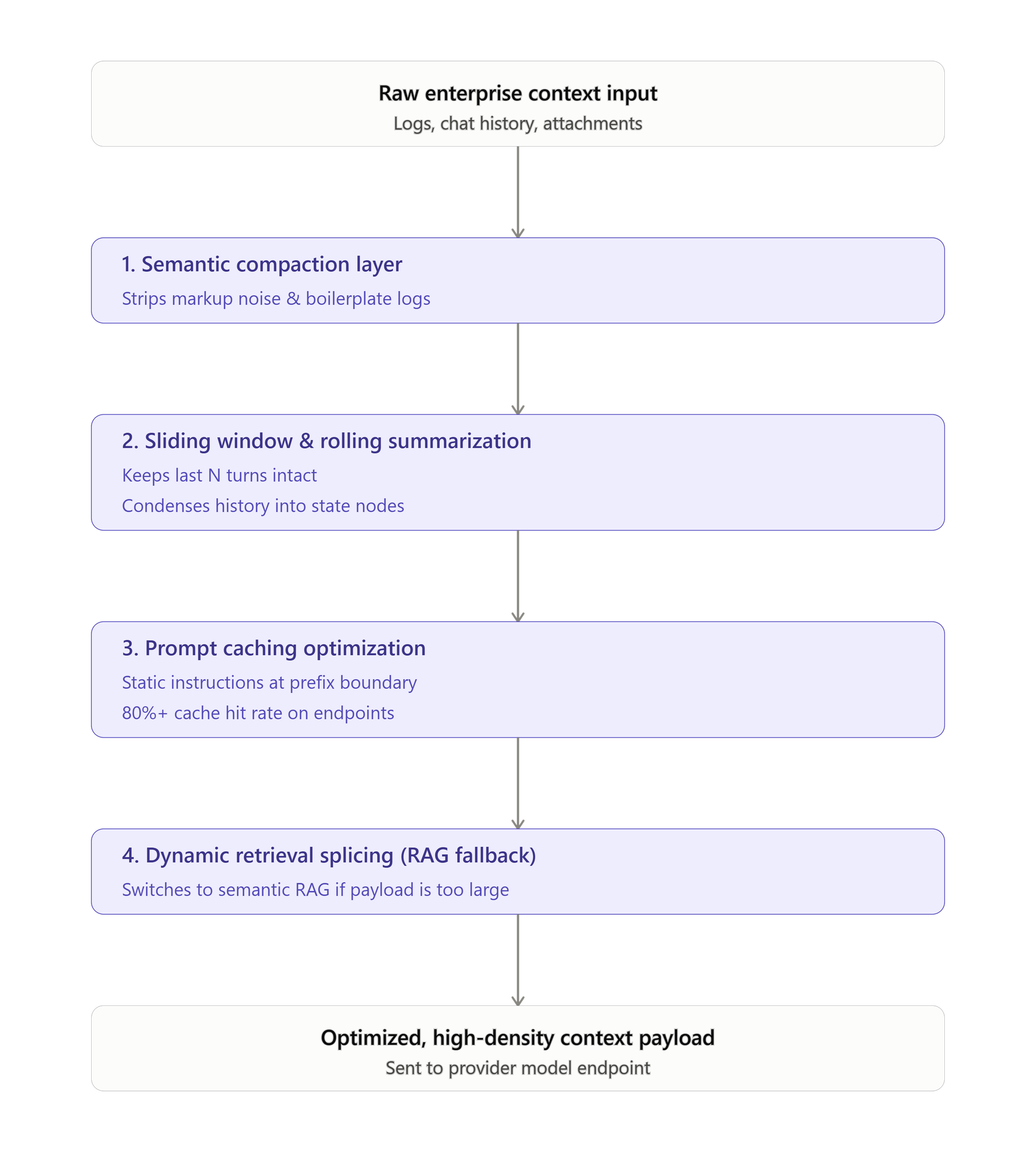
- Semantic Context Compaction Raw data (HTML pages, JSON dumps, system logs) is filled with structural noise. Before hitting the context window, compaction pipelines strip out redundant whitespace, convert verbose JSON into compact key-value pairs, and remove irrelevant tags—reducing token volume by 30–50% without losing semantic meaning.
- Rolling Hierarchical Summarization Instead of passing full conversation histories, background asynchronous workers summarize chat histories into structured state models:
- Active Window: The last N turns are kept verbatim for full conversational nuance.
- State Summary: Older turns are summarized into a concise, running state containing verified facts, key decisions, and unresolved user intents.
- Strategic Prompt Caching Architecture Leveraging Prompt Caching reduces costs by up to 80% and slashes TTFT on repeated context prefixes. By structuring system prompts so static elements (instructions, enterprise knowledge bases, tool schemas) sit strictly at the beginning, only volatile user input remains at the trailing edge.
- Context Budgeting & Dynamic RAG Escalation Strict token budgets are enforced for every agent call. If an incoming context payload exceeds its pre-allocated budget (e.g., 8,000 tokens), the system dynamically downgrades from a "full context dump" to a targeted RAG pipeline—retrieving only the top-K relevant chunks via vector search.
What’s Next?
Sign up and explore now.
🔍 Learn more: Visit our blog and documents for more insights or schedule a demo to optimize your enterprise AI context management.
📬 Get in touch: Join our Discord community for help or Contact Us.
Stay Connected
💻 Website: meganova.ai
📖 Docs: docs.meganova.ai
🎮 Discord: Join our Discord
👽 Reddit: r/MegaNovaAI
𝕏 X: @meganovaai