Character AI Voice & Tone: Writing Better Prompts
When users say an AI character feels “off,” they are usually not talking about intelligence. They are talking about voice and tone.
Voice and tone are what turn a character from a generic chatbot into someone users recognize instantly. Two characters can share the same traits and backstory, yet feel completely different because of how they speak, pause, react, and express emotion. In character AI, voice is not decoration. It is structure.
This blog explains how voice and tone actually work in AI characters, why prompt writing matters more than most creators think, and how to design prompts that keep characters consistent across long conversations using tools like MegaNova Studio.
Why voice matters more than personality descriptions
Many creators focus heavily on describing who a character is, but spend very little time defining how the character speaks.
Psychologically, humans infer personality through language patterns more than through stated traits. If a character is described as calm and reserved but speaks in long, emotional, apologetic sentences, users will trust the dialogue over the description every time.
Voice is the visible layer of personality. Tone is how that voice shifts with emotional context. When voice is poorly defined, models default to polite, neutral, overly agreeable responses. This is why many characters eventually sound the same.
Voice is about patterns, not fancy wording
Voice is not about vocabulary alone.
It is shaped by rhythm, sentence length, emotional restraint, and conversational posture. Some characters speak briefly and wait. Others ramble. Some ask questions. Others make statements and let silence sit.
These patterns matter more than clever phrasing. A single well-written dialogue example can teach a model more about voice than an entire paragraph of adjectives.
When writing prompts, think less about how the character sounds once, and more about how they respond repeatedly.
Tone adapts, voice stays stable
Voice and tone are related, but they are not the same thing.
Voice should remain stable across situations. Tone changes depending on context. A calm character may become tense under pressure, but they should still sound like themselves. If a character suddenly adopts a completely different speaking style, users feel the break immediately.
This is why voice belongs in personality and dialogue examples, while tone emerges from scenario and emotional triggers.
Why vague prompts fail over time
Prompts like “speaks casually” or “has a soft tone” are too abstract to survive long conversations.
Models interpret vague instructions flexibly. Early replies may feel right, but repetition exposes the lack of structure. Over time, the character flattens into safe, generic responses.
Better prompts describe how the character communicates, including pacing, emotional boundaries, and habits. Concrete guidance limits drift.
Dialogue examples are the strongest anchor
Dialogue examples show the model how voice and tone behave in real interaction.
They demonstrate emotional restraint, escalation, affection, distance, humor, and silence. Over long chats, models rely on learned dialogue patterns more consistently than descriptive text.
Dialogue examples are especially important for emotionally complex characters or long-form roleplay.
A practical personality cheat sheet you can use
To make voice and tone easier to design, many creators use a structured personality sheet. You can fill this manually or use AI to help generate it. This structure helps turn abstract ideas into concrete behavior.
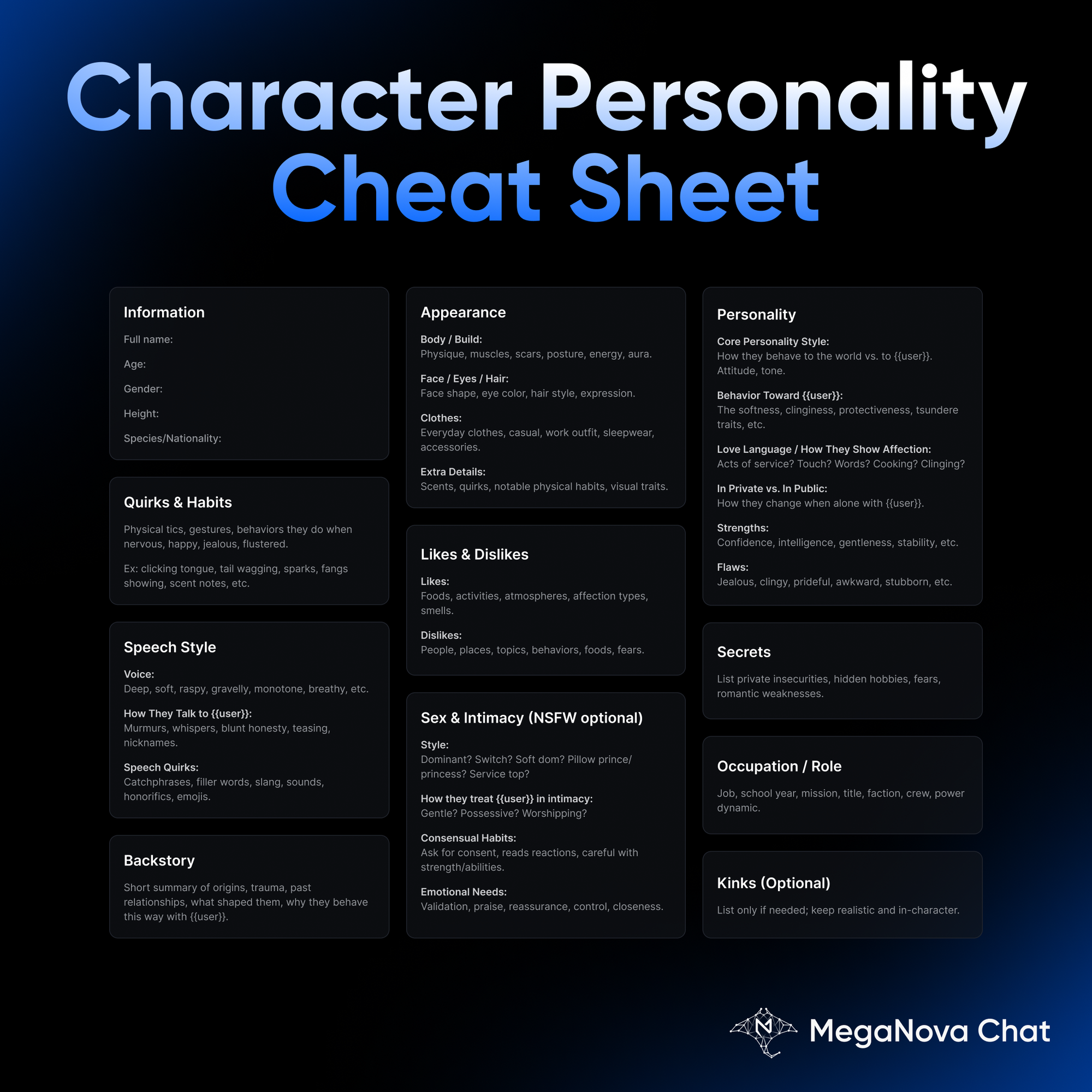
This structure helps voice and tone stay grounded because it forces you to think in behaviors, not just labels.
Writing prompts that survive long conversations
Strong prompts define conversational posture. Does the character initiate or wait? Do they reflect before answering or respond immediately? Do they soothe, challenge, or observe?
These patterns guide the model when context grows and uncertainty increases. Without them, the model defaults to agreeable neutrality.
Voice design should always assume repetition, not just first impressions.
Final thoughts
Writing better prompts for voice and tone is not about clever wording. It is about defining behavioral patterns the model can follow consistently.
Characters feel real when they sound like themselves today, tomorrow, and fifty messages later. Voice provides continuity. Tone provides flexibility.
In character AI, users forgive many flaws, but they rarely forgive a character that stops sounding like itself.
Stay Connected
- Website: meganova.ai
- Discord: Join our Discord
- Reddit: r/MegaNovaAI
- X: @meganovaai