Building Multi-Character Worlds: Advanced Techniques
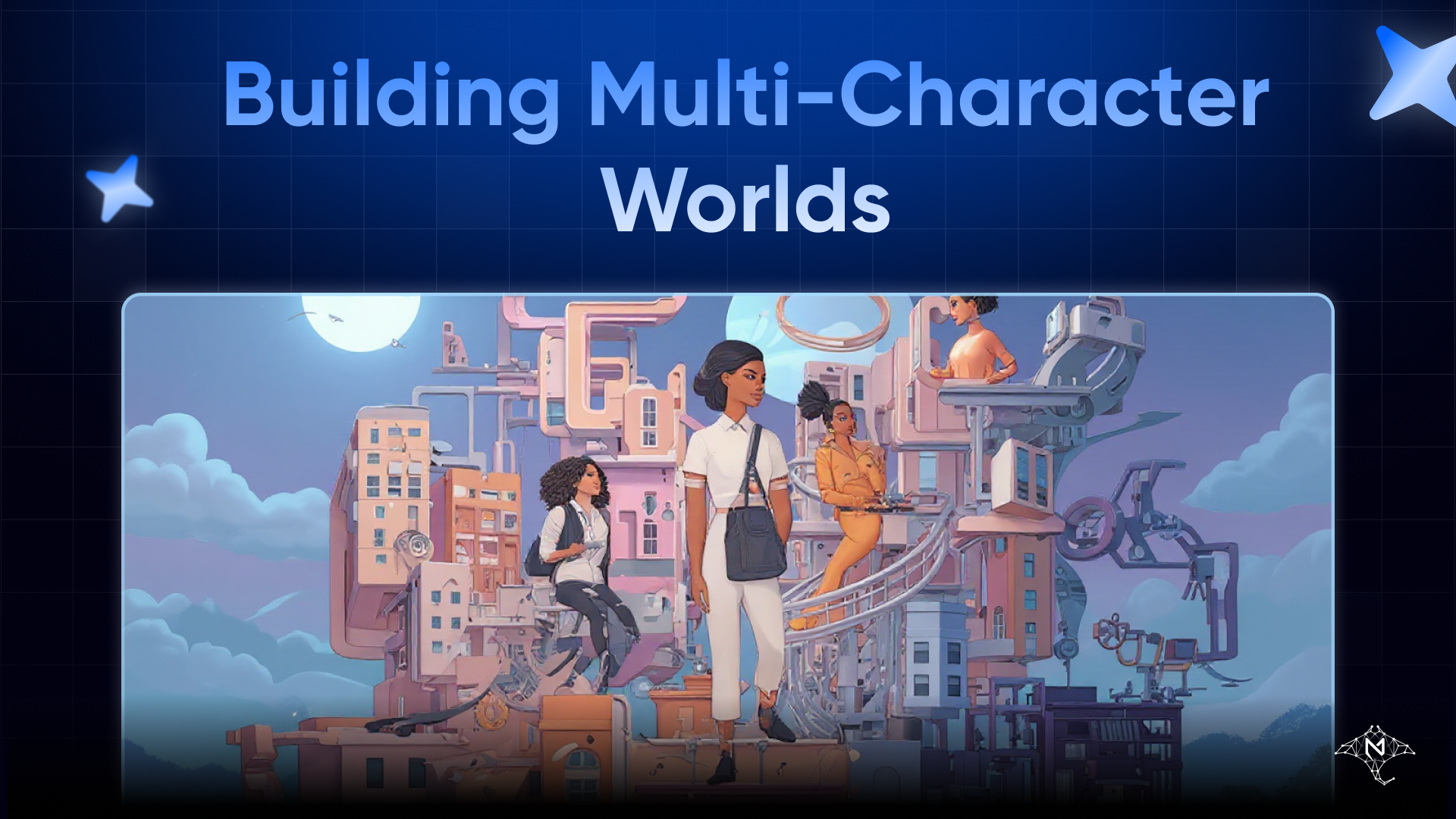
Single characters are easy to design.
Worlds are not.
The moment you introduce more than one AI character, new problems appear. Voices blur together. Personalities overlap. Continuity breaks. Characters forget how they relate to each other. What felt immersive with one character becomes fragile with five.
This blog explores advanced techniques for building multi-character worlds that actually hold up in long-form roleplay, and how creators apply these techniques using structured workflows in tools like MegaNova Studio.
Why multi-character worlds fail so often
Most failures come from treating multiple characters as separate projects.
Creators design each character in isolation, then place them in the same setting and hope it works. Psychologically, this creates conflict. Characters lack shared assumptions. Relationships are undefined. Reactions feel random because there is no common frame of reference.
Worldbuilding is not additive. It is relational.
Characters only feel real when their behavior makes sense relative to others.
Start with a world spine, not characters
Advanced worldbuilding starts with constraints.
Before designing individual characters, define a small number of world rules that apply to everyone. These rules act as a spine that keeps behavior consistent across the cast.
Good world rules answer questions like:
- What kind of world is this, emotionally and socially?
- What behaviors are normal here?
- What behaviors are taboo?
- How do power, trust, and conflict usually work?
Characters can disagree, but they should disagree within the same reality.
Design relationships as first-class objects
In multi-character systems, relationships matter more than traits.
A character is not just “confident” or “reserved.” They are confident with one character, guarded with another, and deferential with a third. These differences are where realism emerges.
Instead of describing characters independently, define key relationships explicitly:
- allies
- rivals
- mentors
- unresolved tensions
- emotional dependencies
This prevents characters from interacting as strangers every time.
Avoid personality overlap at all costs
Nothing breaks immersion faster than characters who sound the same.
In ensemble design, uniqueness matters more than depth. Each character should own a distinct conversational space. That space can be defined by:
- speaking rhythm
- emotional range
- conversational role
- decision-making style
If two characters could swap dialogue without users noticing, one of them should be redesigned.
Use role separation to stabilize behavior
One of the most effective techniques is role locking.
Each character should have a clear functional role in the world. Narrator, instigator, mediator, observer, leader. Roles guide behavior when the model is uncertain.
When roles are clear, characters react differently to the same event in believable ways. Without roles, everyone reacts generically.
Role clarity reduces drift dramatically.
Shared memory is about state, not dialogue
Creators often try to share dialogue history across characters. This rarely works.
What matters is shared state. What happened. What changed. Who knows what. Who is hiding what.
Instead of passing conversations, summarize world state:
- recent events
- current tensions
- relationship shifts
- unresolved consequences
State keeps the world coherent without overwhelming context.
Control interaction patterns, not just personalities
Advanced worlds define how characters interact, not just who they are.
Do characters interrupt each other? Do they wait their turn? Do they speak indirectly or confront issues head-on? Are conflicts resolved quickly or allowed to linger?
These interaction rules shape the feel of the world more than individual backstories.
When interaction patterns are consistent, even simple characters feel grounded.
Test characters together, not alone
Many creators test characters individually, then release them as a group.
This is a mistake.
Multi-character worlds must be tested in interaction. Characters should be placed in shared scenarios and pushed through conflict, collaboration, and emotional shifts together.
Look for:
- voice collapse
- role confusion
- repeated phrasing
- inconsistent reactions
Problems that do not appear in solo testing almost always appear here.
Scale slowly and intentionally
Strong worlds grow in layers.
Start with two or three characters. Stabilize their relationships. Introduce tension. Only then add more characters. Every new character increases complexity exponentially.
Scaling too fast leads to shallow interactions and broken continuity.
Patience is an advanced technique.
Why tools matter more at scale
As worlds grow, unstructured prompts stop working.
Multi-character design benefits from tools that separate:
- personality
- relationships
- world state
- dialogue patterns
Structured workflows make it possible to update one character without breaking others. They also make iteration safer, because changes stay local instead of cascading unpredictably.
This is where studio-style creation environments outperform single-prompt setups.
Final thoughts
Building multi-character worlds is not about writing more. It is about designing systems of behavior.
Successful worlds rely on shared rules, clear roles, defined relationships, and controlled interaction patterns. Characters feel real not because they are complex, but because they behave consistently with each other.
When done well, multi-character worlds stop feeling like a collection of bots and start feeling like a living space. That is the difference users notice and come back for.