AI Agent Runtime vs Agent Framework: What’s the Difference?
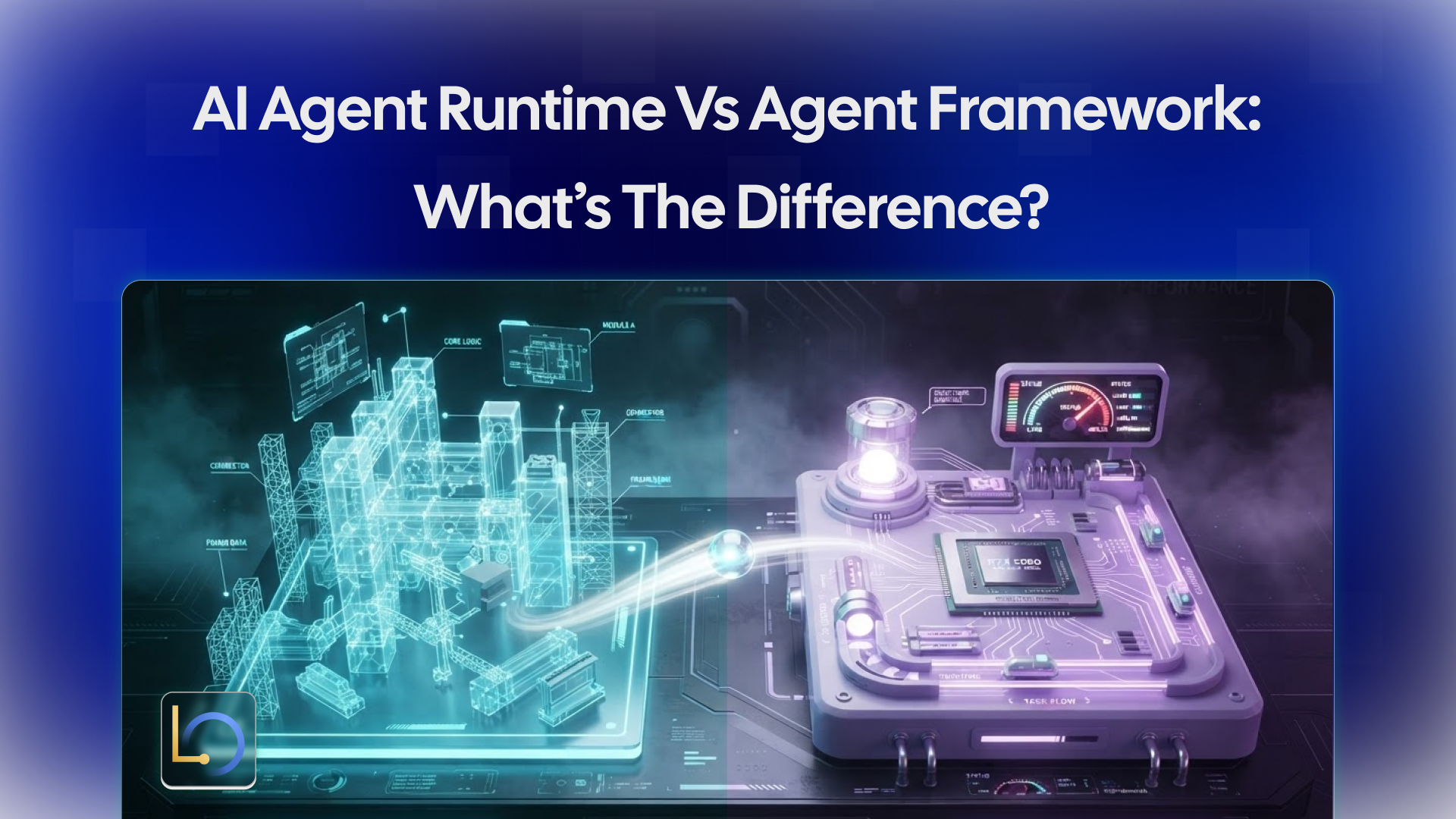
"Framework" and "runtime" get used interchangeably in AI agent conversations, but they answer different questions. A framework answers how do I write an agent? A runtime answers where does my agent run, and what keeps it working once it's live?
The difference shows up the moment an agent leaves a notebook. Someone has to store conversation state, connect knowledge sources, call tools safely, pause for approvals and keep a record of what happened. With a framework, that work is yours to build around it. With a runtime, much of it is the runtime's job. This guide explains both, compares them side by side, and ends with questions to ask before you choose.
What each one is
- An agent framework is a library you write code against. It gives you building blocks: ways to compose prompts, define tools, chain steps and coordinate agents. The agent runs inside your own application process, and everything around it, from where state is stored to how approvals and logs work, is part of the code and infrastructure you build and operate.
- An agent runtime is a running layer your application calls. It executes the agents and keeps the pieces they depend on in one place. LibraOS describes itself this way: the AI runtime for your apps, the execution layer that runs agents, memory, knowledge and tools beneath your own interface. Your app keeps its code and user experience, and talks to the LibraOS Runtime through supported APIs.
A simple way to picture it: a framework is a toolkit for building the engine; a runtime is an engine you install and drive.
Side by side
Frameworks differ from one another, and some ship helpers for parts of this list. The framework column describes the typical case, so check the specific framework you're considering.
| Agent framework | Agent runtime | |
|---|---|---|
| What it is | A library inside your code | A running service your app calls |
| Where agents run | In your application process | In the runtime |
| Conversation state and memory | Varies by framework; you usually choose, wire up and operate the store | Part of the runtime |
| Knowledge retrieval | Varies by framework; you usually connect a vector store and indexing | Part of the runtime |
| Tools | You define and call them in your code | Connected to agents in the runtime |
| Approvals and audit | Usually assembled from separate components, to varying degrees | Configured in the runtime for the tasks that run through it |
| Deployment | Wherever your app runs | Wherever the runtime runs: self-hosted, private or air-gapped, or a hosted edition |
| Language | Tied to the framework's language | Called over its APIs |
| Control over internals | Very high | Within what the runtime exposes |
In LibraOS, the runtime column maps to four parts: agents coordinate tasks and connect tools, memory carries useful context across sessions, knowledge retrieves from your connected sources, and control defines policies, approvals and audit.
When each one fits
A framework fits when:
- You're prototyping and want to see results quickly in code you already write.
- The agent lives inside one application, and you're comfortable owning state, storage and logs.
- You need fine-grained control over every step of the agent's logic.
A runtime fits when:
- Several apps or teams should share the same agents, memory and knowledge.
- Context has to persist across sessions, and you'd rather not build and maintain that layer.
- Actions need permissions, approval points and an audit record.
- The deployment matters: on-premise, in a private cloud, air-gapped, or in a specific jurisdiction.
Using both. The two aren't mutually exclusive. Your application can keep its own orchestration code while the runtime runs the agents and holds memory, knowledge and controls. What matters is being clear about which layer owns what, because controls only apply where the work actually runs: tools and network calls your own code makes outside the runtime need their own enforcement.
The overhead question
A fair worry about any runtime is that it adds a layer to every request. LibraOS publishes a controlled benchmark on its homepage that measures runtime overhead using a mock model:
| Measure | LibraOS result | Test setup |
|---|---|---|
| Throughput | 244 runs/s | 256 concurrent runs, mock model |
| Idle memory | 52 MB RSS | LibraOS v0.2.2, fresh database |
| CPU per run | 10.9 ms | Sequential mock-model test |
The conditions travel with the numbers. Because the test uses a mock model, it measures the runtime's own overhead, not model speed. The homepage also compares LibraOS with other frameworks; in that comparison LangGraph was run with langgraph dev, and polling affects its throughput. By the homepage's own account, these results do not establish production deployment superiority. Results also depend on the machine and configuration, so treat them as a starting point and test with your own models and workload.
Questions to ask before you choose
Whether you're comparing frameworks, runtimes or both, these questions cut through feature lists:
- Where will the agents run, and does that meet your data-placement requirements?
- Who stores conversation state and memory, and who maintains that store?
- How does knowledge retrieval work, and which embedding model does it need?
- How are actions controlled: can you set permissions and approval points, and is there an audit record?
- Which models can you use: your own provider key, local models, or hosted inference?
- What happens when a run is interrupted, and what does recovery depend on?
- What does it cost to operate, including the infrastructure you'll run around it?
- How will you test it with your own models, traffic and failure cases before launch? (See How to Evaluate AI Agents Before Launch with LibraOS.)
If a framework leaves most of these to you, that's not a flaw; it's the trade-off for control. A runtime should answer more of them out of the box, and say plainly where its responsibility ends.
Conclusion
A framework helps you write agents; a runtime runs them and holds what they depend on: memory, knowledge, tools and controls. Choose a framework when you want maximum control inside one app and are ready to build the surrounding layer. Choose a runtime when agents need persistent context, shared knowledge, approvals and a specific deployment. Either way, ask where each piece lives, and test on your own workload before you commit.
Explore LibraOS: libraos.com
Sources
What’s Next?
Sign up and explore now.
🔍 Learn more: Visit our blog and documents for more insights or contact us for a demo of how MegaNova can power your AI products.
📬 Get in touch: Join our Discord community for help or Contact Us.
Stay Connected
💻 Website: meganova.ai
📖 Docs: docs.meganova.ai
🎮 Discord: Join our Discord
👽 Reddit: r/MegaNovaAI
𝕏 X: @meganovaai